Governor's Day with Farmers – For more discussion with local actors

By

By Larissa Stiem-Bhatia and William Onura

In agriculture, it remains important to include political stakeholders in the discourse. To build the bridge between practical application and political action, the think tank TMG launched the Governor's Day with Farmers in Kakamega County, Kenya. It has now taken place for the second time. But what are the goals and benefits of the Governor's Day?


Governor Barasa speaks to participants at Governor's Day with Farmers 2023. © Peter Muriungi

By TMG Research gGmbH

TMG Research gGmbH as part of the TMG Think Tank for Sustainability supports the implementation of sustainable development targets and the Paris Climate Agreement. The work of TMG Research gGmbH aims to listen to the voices of local actors in global processes while at the same time influencing the global processes in such a way that they become effective for concrete transformation processes at the national and local level

All contributions


Kakamega County, in the western part of Kenya, can be viewed as a text book case of unfulfilled potential. While it has not escaped the ravages of climate change, the county enjoys relatively high rainfall and an abundance of fertile land. Yet, according to the Kakamega County government, three out of ten county residents are food insecure.


Currently, policies to boost agricultural production and farm-based livelihoods rarely involve farmers and other community-level stakeholders who experience these realities every day. However, farmers need – and should – play a vital role in the governance of food systems (transformation). This disconnect was the trigger for an innovative county-wide initiative: Governor’s Day with Farmers.


With support from TMG Research GmbH and the German development organization GIZ, a network of local women and farmer organizations approached the Kakamega County government to propose a new approach for farmers to directly influence agri-food policy. Held for the first time in February 2022, Governor’s Day with Farmers (GDF) was convened by Shibuye Community Health Workers (CHW), a community-based women’s organization, the Kakamega County Farmers Association (KACOFA) – which is part of the umbrella Kenya National Farmers’ Federation – the Kakamega Youth Agripreneurs, and the county government.


The GDF was conceptualized as more than an event.


It aims to become a county-wide (and eventually national) platform through which farmers can interact directly with the political leadership in the agri-food sector to address their concerns and interests.
 

Farmers’ issues are presented in the form of a declaration, which is endorsed by the Governor, other top policy makers, and farmer representatives at the close of the Day. As highlighted by Violet Shivutse, Director of Shibuye CHW, the declaration is more than a piece of paper. The ultimate goal is to ensure that issues raised by farmers are taken up in the county planning process, so they can become mainstreamed in county budgets and programme implementation. Reflecting on the first GDF, she expresses pride that upon signing the first Declaration, “… the Governor even instructed the county minister of agriculture to go ahead and give us someone from the county who can work with us as communities, as farmers, to ensure that it goes into the [county development] plan.”


Ich bin ein Alternativtext
Violet Shivutse, Head of Shibuye CHW, and Habakkuk Khamaala, Chairman of KACOFA, sign copies of the GDF 2023 Declaration in the presence of Governor Barasa. © Boniface Mmbeshi / Shibuye CHW

The 2023 GDF Declaration highlighted the following issues of concern: extension service delivery, access to land, farmer representation in policy making and county flagship projects and soil health, and markets. Governor Barasa affirmed his commitment to improving extension services as a key priority. This was further underlined by county agriculture minister Benjamin Andama, who noted the reason: “The issue of extension is key because that's where information is going to be disseminated and that's where we are going to reach that farmer.”
 

Ich bin ein Alternativtext
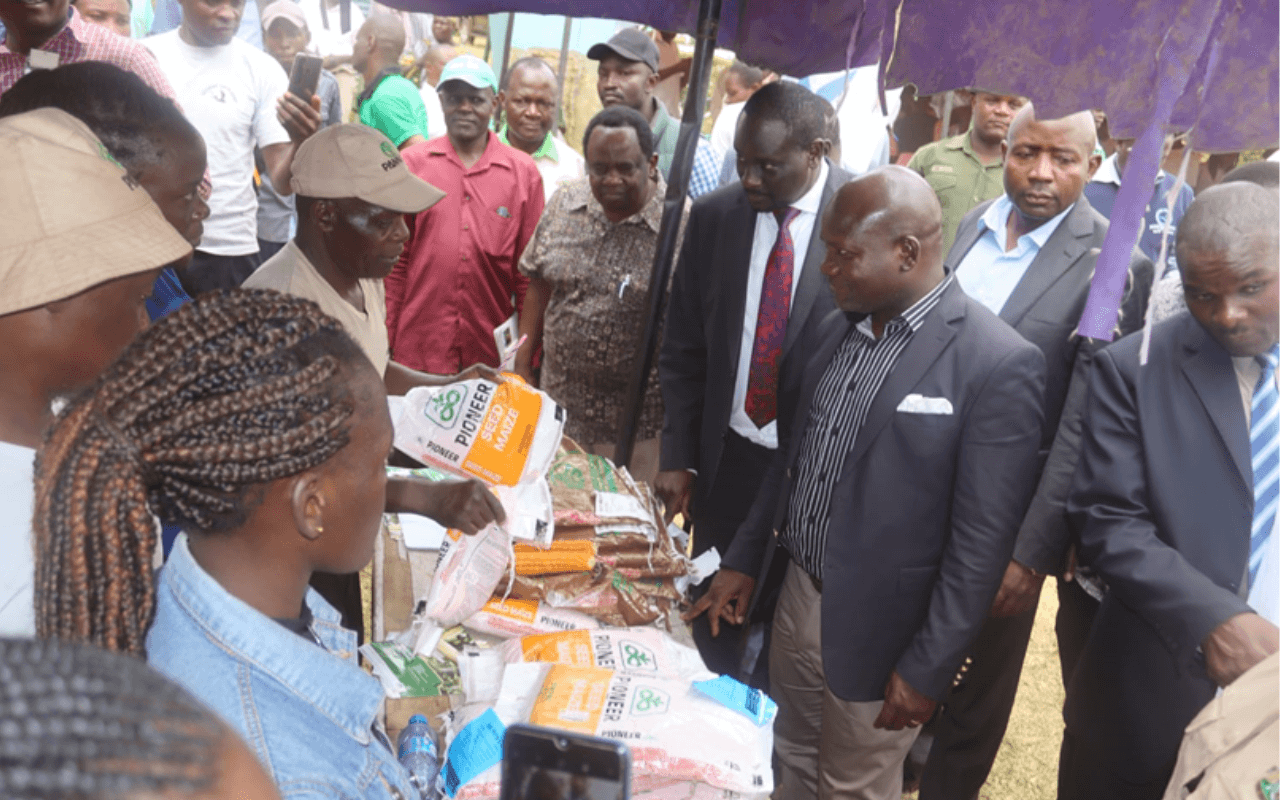
County government representatives led by Governor Fernandes Barasa (second from right) visit an exhibition stand on the occasion of the Second Governor's Day with Farmers (GDF). © Ali Makame

With so many farmers’ fairs and multi-stakeholder platforms mushrooming in the country, many might wonder what is unique about the GDF.


Broadening the base: The successful conclusion of the second Governor’s Day with Farmers on 22nd of February this year has made it more apparent that this initiative could evolve into a truly farmer-driven, and collaborative initiative. While the first GDF was largely organized and funded as part of a TMG research project, the second GDF was entirely led by local farmers and civil society organizations – with women as a key driving force. Moreover, a broader and more diverse set of co-host organizations was involved in planning and organization of the event, including Masinde Muliro University of Science and Technology, Anglican Development Services, Cereal Growers Association, and Transparency International.


Growing legitimacy: Second, the GDF has significantly grown in size in just one year, indicating its potential to continue to magnify farmers voices, strengthen their negotiation power and put pressure on politicians to live up to their commitments. Around 2,000 farmers – double the number of at the inaugural edition – witnessed the signing of the farmers’ declaration by their Governor. As noted by Violet Shivutse, the high number of farmers – and potential voters – really matters: “So the number of farmers showing up to the governor's Day already exerts pressure on the governor to say: Oh look here, we are watching, we want you to do this.”


Strengthening accountability: Third, the GDF provides a unique opportunity for direct interaction between farmers and the top policy makers. As observed by Jael Omunyang’oli, County Assembly member, the objective of GDF is “… number one, to have a sit down, or round table engagement, with the policymakers to ensure that if there's any legislation that is pending, if there's any idea, they want to put forth for the policymakers, it can be tabled on that day.”


The continuing success of Governor’s Day with Farmers will, however, depend on the extent of effort made in preparing for and following up with the relevant stakeholders.


The process did not end with the celebration at Bukura Agricultural Training Centre, as noted by Habakkuk Khaamala, KACOFA Chairperson, but requires intensive follow up. He emphasized KACOFA’s commitment to continue to engage the county government through the Ministry of Agriculture, “…to make sure that all the topics on the declarations have been acted on.“


Food and nutrition security, intact ecosystems and sustainable rural development are becoming more crucial as the world faces increasing hunger, climate change and ecological degradation challenges. In an effort to transform our food systems, policy makers, researchers, and programme implementers are pondering on the question of how such transformation processes can be governed while ensuring the relevant stakeholders have a seat at the table.


The Governor’s Day with Farmers can be one piece of this puzzle by giving farmers and local communities a strong voice.


Habakkuk Khaamala, Chairperson of KACOFA, sees a lot of potential in the GDF, not only in Kakamega, but the entire country. “If we have many counties having the Governor's Day, it will become a strong farmers’ movement and better show how [policy makers] can assist the farmers and include them even further in policy making.”


This article has been published first on the TMG website.


Similar articles

© GIZ / Ollivier Girard

"The virus does not need visa"

Interview by Dr. Ahmed Ouma (CDC)

Countries across Africa coordinate their efforts in the fight against corona by the Centre for Disease Control (CDC) of the African Union in Addis Abeba. Until now, the curve of new infections has been successfully flattened – why? Dr. Ahmed Ouma, Deputy Director, explains the work of CDC in an interview with Tilman Wörtz.

Read more

A man in camouflage distributes food to people, including women and children, from a large pot outdoors.

5 questions to F. Patterson: Why is there more hunger?

Interview with Fraser Patterson

Every year in October, the "Welthungerhilfe" aid organisation, with the Irish "Concern Worldwide" NGO, publishes the Global Hunger Index, a tool with which the hunger situation is recorded. What are the trends - and what needs to be done?

Read more

Stephan Exo-Kreischer ist Deutschland-Direktor der Lobby- und Kampagnenorganisation ONE.

New campaign for women: "Poverty is sexist"

Interview with Stephan Exo-Kreischer

This is a benchmark for everybody: More rights for women are a very influencing solution in the struggle against extreme poverty and hunger worldwide, says Stephan Exo-Kreischer, Director of ONE Germany. The organisation specialises in political campaigning as a lever for sustainable change.

Read more

“We have to prepare for the unexpected”

Interview with Dr Maria Flachsbarth (BMZ)

In August, Germany’s development ministry set up a division concentrating on One Health topics. Parliamentary State Secretary Maria Flachsbarth on knowledge gaps at the human-animal-environmental interface, the link between One Health and food security, and lessons learnt from previous pandemics.

Read more

A focused worker in blue coveralls operates machinery, wearing safety goggles on his head.

More than just a seat at the table

A contribution by Welthungerhilfe

Africa is home to the world’s youngest and fastest growing population. For many young people, agriculture could offer a job perspective. But to improve the living conditions and job prospects of young people in rural areas, political reforms and investments are desperately needed, as these people will be at the centre of agriculture and agricultural development in the future.

Read more

Teilnehmer einer Schulung im Digital Transformation Center Kigali, Ruanda. © Mali Lazell, GIZ

Africa's rapid economic transformation

A report by T. S. Jayne, A. Adelaja and R. Mkandawire

Thirty years ago, Africa was synonymous with war, famine and poverty. That narrative is clearly outdated. African living standards are rising remarkably fast. Our authors are convinced that improving education and entrepreneurship will ensure irreversible progress in the region even as it confronts COVID-19.

Read more

Förderung einer nachhaltigen Landwirtschaft, Burkina Faso. Foto: Aude Rossignol, GIZ

Building our food systems back better

A contribution by Jes Weigelt and Alexander Müller

What is required to make food systems provide sufficient, healthy food while not harming the planet? How should food security be maintained given the threat posed by climate change? Our authors look at some aspects of tomorrow’s food systems against the backdrop of the corona crisis.

Read more

A small roadside shop with colorful signage stands under a clear blue sky next to a parked truck.

The state of food security in Cape Town and St. Helena Bay

A study by Markus Hanisch, Agustina Malvido, Johanna Hansmann, Alexander Mewes, Moritz Reigl, Nicole Paganini (SLE)

Post-Covid-19 lockdown: How food governance processes could include marginalised communities - an extract of the results of an SLE study applying digital and participatory methods.

Read more

A group of women, some wearing green "d.light" shirts, gather for a photo in a well-lit room.

How the self-help approach empowers smallholder women

A report by INEF and Kindernothilfe

Supporting groups of smallholding women substantially contributes to strengthen rural operations economically. The organisation and associated group activities can help to reduce extreme poverty and improve the food situation.

Read more

Four smiling children joyfully eat together at a table, sharing bowls of food in a warm, vibrant setting.

School Feeding: A unique platform to address gender inequalities

A contribution by Carmen Burbano de Lara (WFP)

Besides the well known impacts of Covid19 lockdowns for the adult population, the associated school closures led to 90 percent of the world’s children with no access to schools. However, school meals are in often the only daily meal for children. Without access to this safety net, issues like hunger, poverty and malnutrition are exacerbated for hundreds of millions of children.

Read more

(c) Christoph Pueschner/Zeitenspiegel
Somalia / Mogadischu, Juli 2011: diese Frau floh mit ihren Kindern aus dem 250 Kilometer entfernten Baidoa in das IDP-Camp Al-Hidaaya. © Christoph Püschner/Zeitenspiegel

Global responsibility: Tackling hunger is the only way forward

A contribution by Lisa Hücking (WHH)

Chancellor Merkel has begun an ambitious European political programme: Striving for compromise in budget negotiations, an orderly Brexit as well as an appropriate response to the corona crisis. Unfortunately, one of her positions that she previously held is nowhere to be found: Africa's prosperity is in the interest of Europe. 

Read more

A woman in Burkina Faso feeds her baby while children sit against a rustic wall in the background.

Hunger must not be a consequence of the epidemic!

A contribution by Michael Brüntrup (DIE)

Even though COVID-19 poses a threat to the health of humanity, the reaction to the pandemic must not cause more suffering than the disease itself. This is particularly relevant for poor developing countries, where the impact of the corona crisis on food security is even more severe!


Read more

A man in a suit gestures expressively during a conversation, with green plants in the background.

Spiritual mortar for the young generation

A contribution by Jan Rübel

Fred Swaniker is working building a new era of leaders. And what about agriculture? ‘It needs to be more sexy!’

Read more

A person stands on a rocky hill, overlooking a vast, scenic landscape with a towering cliff and expansive fields below.

Human Rights, Land and Rural Development

A contribution by Michael Windfuhr (German Institute for Human Rights)

Land rights are no longer governed by the law of the strongest. That is what the international community has agreed to. Governments and private companies have a duty to respect human rights and avoid corruption.

Read more

A man in a cap and blazer speaks at a podium during a presentation on small business competition winners.

How do you campaign “Food Systems”?

Interview with Paul Newnham, Director of the SDG 2 Advocacy Hub.

The UN Food Systems pre-Summit in Rome dealt with transforming the ways of our nutrition. How do you bring that to a broad public? Questions to Paul Newnham, the Director of the Sustainable Development Goal (SDG) 2 Advocacy Hub.

Read more

A globe surrounded by farms and food illustrates the global impact of food loss and waste, with a "Driven to Waste" headline.

How much do we actually waste, Mr. McFeely?

An interview with Peter McFeely (WWF)

The WWF has published a sensational study on food waste. The focus: farm-stage food waste. Peter McFeely, Global head of communications and strategic planning at WWF, explains what needs to be done.

Read more

Farmers work together weeding a lush green maize field under a clear blue sky.

How Smallholders became Commodity Suppliers

Small farmers are often left behind in African agriculture. Access to markets and improved competitiveness can only be achieved if the small farms join forces. But those affected in partner countries are often at a loss as to how to implement cooperative models. Here, the BMZ provides support through the SEWOH ONE World – NO Hunger initiative and the Social Structure Promotion (Sozialstrukturförderung).

A project by Deutscher Genossenschafts- und Raiffeisenverband e. V.

Read more

A complex network of colorful wires is intricately connected on a white circuit board, demonstrating electrical engineering.

The Future of Development Politics: Voices from the Parliamentary Groups
A Contribution by Journalist Jan Rübel

Representatives of the six parliamentary groups offer their views on the future of German development cooperation.

Read more

Two women are tending to rows of seedlings in a lush, organized nursery garden.

Cooperation and Effective Incentives for Sustainable Land Use

A Contribution by GIZ

The second GFFA expert panel highlights the need for governance action to reverse global trends of land degradation.

Read more

A woman in a floral dress stands peacefully in a lush green field under a cloudy sky.

What Needs to Change for Africa’s Youth, Ms Kah Walla?

An Interview with Kah Walla

A conversation with the activist and entrepreneur Kah Walla about what needs to change for young people in rural Africa.

Read more

A tree trunk is covered with locusts as a group of people and goats stand in the background.

Building Better Resilience to Transboundary Threats

A Contribution by the TMG Think Tank for Sustainability

Fuelled by climate change, desert locust plagues become increasingly frequent. A plaidoyer for a paradigm shift on handling transboundary crises.

Read more

Three people stand smiling on a modern staircase with photographers capturing the moment, reflecting a formal event.

From shared conviction to global response

A Contribution by Jan Rübel

The G7 is responding to the worsening global hunger crisis by mobilizing an additional $4.5 billion for this year alone. A key milestone for this in the run-up was the international conference on global food security "Uniting for Global Food Security".

Read more

Golden wheat stalks sway under a clear blue sky, capturing a serene agricultural landscape.

A dashboard as a key tool for global food security

A Contribution by BMZ

The Global Alliance for Food Security (GAFS), jointly launched by the German G7 Presidency and the World Bank, released the Global Food and Nutrition Security Dashboard during COP27: A Rapid Response Tool for Coordinating Global Action for Food Security.

Read more

A panel discusses food system transformation at the Global Forum for Food and Agriculture 2023, with a speaker at the podium.

How to govern food systems transformation

A contribution by Daniel Montas and Jan Rübel

The transformation of food systems is regarded as the new magic code, but effective strategies are lacking. A new group of experts discussed the prerequisites for efficiently managing this process. The experts representing politics, youth, civil society, farmers' organizations, private sector, and academia unanimously concluded: transformation is possible, but it needs a strong drive from within.

Read more

A winding road cuts through lush green mountains under a vast, clear sky, showcasing nature's breathtaking beauty.

“We want to overcome hunger and poverty”

An interview with Fernanda Machiaveli

After four years of the Bolsonaro administration, the new Brazilian government is trying to restart its engagement in agroecology, fighting deforestation in the Amazon and protecting indigenous communities and poor families from hunger. An interview with the Vice-minister for Rural Development and Family Farming, Fernanda Machiaveli.

Read more

An aerial view of a rural village showcases a network of dirt roads winding through houses and greenery.

“We have to focus on sustainability”

An interview with Karen Mapusua

Karen Mapusua, President of IFOAM Organics International Network, on the danger of the current fuel crises and inflation to loose track in sustainablity, why organic farmers should be heard and how the word “crisis” has a very different meaning where she lives in Fiji.

Read more

Aerial view of a lush agricultural landscape in Ethiopia, showcasing neatly arranged crops and a small building. | © GIZ

The Key to Transforming Food Systems Lies in Inclusive Governance

A Contribution by Daniel Montas

Experts from Burkina Faso, Cambodia, Ethiopia, India, Kenya and Malawi came together to discuss inclusive governance in a workshop entitled "Inclusive Governance of Food Systems Transformation". Daniel Montas, TMG Research, on the findings.

Read more

A woman in a red blazer speaks confidently in a modern conference room setting.

Podcast: Fighting world hunger together

Chancellor Angela Merkel in the Podcast of the Federal Government

At the start of World Food Week around World Food Day on 16 October, Chancellor Angela Merkel stressed that the fight against global hunger will only be successful with international responsibility and solidarity (german only).

Read more

A woman leans on a red and blue tractor in a field, using a mobile phone to connect with digital resources.

Can we democratize data in the age of digital extraction?

A contribution by Clare Crowe Pettersson & Lena Bassermann

The United Nations Committee on World Food Security (CFS) recently adopted new policy guidelines on the use of data and digital technologies in the context of food security and nutrition. What comes next?

Read more

A diverse group of people gathers for a photo at a UN event focused on desertification and drought awareness.

A Call to Action against Desertification

A contribution by GIZ

Every second, worldwide, we lose valuable and healthy soil with the size of four football fields. This was only one of the many facts being presented to a wide audience in Bonn and worldwide via livestream at the World Desertification and Drought Day on 17th June 2024. This was the 30th anniversary of the United Nations Convention on Combatting Desertification (UNCCD), which was celebrated at the Bundeskunsthalle in Bonn.

Read more

A person in a yellow shirt holds a tray of eggs, smiling inside a chicken coop filled with hens.

Cultivating tomorrow

A Contribution by GIZ

Africa’s largest youth generation has the potential to transform agriculture sustainably. Young entrepreneurs like Febelsa in Mozambique are building agricultural businesses that fuel local growth.

Read more

A group of professionals engaged in a lively discussion at a round table, with notes and a water bottle visible.

Coordination as a Game-Changer

A Contribution by Emmanuel Atamba & Larissa Stiem-Bhatia

Drawing on dialogues with experts in Kenya, TMG Research releases its latest policy brief highlighting the critical need to strengthen coordination mechanisms in food systems governance. Emmanuel Atamba and Larissa Stiem-Bhatia from TMG Research summarize the results.

Read more

Five women in colorful attire proudly display their land titles in Madagascar, celebrating empowerment and ownership.

Towards more equitable rural realities

A Contribution by GIZ

In the #HerLand campaign for COP16, the UNCCD is focusing on women as key players in conserving soils and combating drought. The Deutsche Gesellschaft für Internationale Zusammenarbeit (GIZ) has also contributed to the campaign focusing on securing women's land rights.

Read more

Participants engage in discussions during the SOILution P4C conference, with speakers addressing the audience from a stage.

Elevating Soil Health for a Sustainable Future

A Contribution by Kah Walla

In May, this year's "Partners for Change – SOILutions for a Food Secure, Resilient, and Sustainable Future" conference took place. Kah Walla, Moderator of the Conference and Director of Strategies!, summarises the discussions and declares that healthy soils are not just the foundation of agriculture, but the cornerstone of a resilient, equitable, and climate-smart future.

Read more

Two men in a lush field discuss data sovereignty, holding papers amidst workers gathering crops.

Empowering farmers to control their own data

A contribution by GIZ

A new study on the digitalisation of agriculture puts farmers back at the centre of their own sector, identifies market gaps and gives recommendations on how to support relevant actors.

Read more

Four people engage in a panel discussion at a podium, with a backdrop featuring agricultural imagery.

And a semicolon in the middle

A contribution by Jan Rübel

After a two-year break due to Corona, the doors of the International Green Week (IGW) in Berlin are opening again. From 20th to 29th January, visitors from all over the world can discover, marvel and taste the produce. But the event is not only feasting and fun. The BMZ stand asks questions about where food comes from & where it goes – and in the process becomes a crash test for many habits.

Read more

Golden hay bales rest on a sunlit stubble field under a clear blue sky, evoking a tranquil rural landscape.

How farmers are facing the crisis

A contribution by GIZ

Russia's war against Ukraine and its impact on food, energy and fertiliser prices is worrying farmers all over the world. Young farmers, farmer organisations and politicians from Kenya, Chad and Ukraine tell their stories and what keeps them in agriculture.


Read more

A woman in glasses and a patterned coat gestures while engaging in conversation at a social gathering.

Priscilla Impraim and her chocolate business

A contribution by Jan Rübel

Priscilla Impraim is one of the first women in Ghana to enter the chocolate business. Despite some hurdles, she founded the company Ab Ovo Confectionery Limited in 2006 with currently six permanent employees and 25 seasonal employees.

Read more

The image illustrates five climate-friendly agricultural methods with simple line drawings and highlighted text.

Five climate-friendly methods in agriculture

A Listicle for climate protection and adaptation

These five management practices can increase agricultural production and contribute to climate change mitigation and adaptation.

Read more

A farmer irrigates a lush green field with a hose under a clear sky in Tanzania, utilizing solar irrigation techniques.

Water may offer the only chance

Interview with Caroline Milow and Ramon Brentführer

Groundwater resources remain dormant in the soil of African regions. Where does it make sense to use them – and where does overexploitation of nature begin? Caroline Milow (GIZ) and Ramon Brentführer (BGR) talk about potentials in the future and lessons from the past.

Read more

Hands display a colorful variety of chillies, including red, green, and orange, showcasing 2023 Black Mamba chillies.

Sandisiwe Dlamini and the chilli pepper business

A portrait by Jan Rübel

By processing chilli peppers, Black Mamba wants to give something back to the rural population. In a short portrait, Sandisiwe Dlamini, Food Safety Officer, reveals how.

Read more

Women in colorful attire joyfully thresh grain in a sunny, rural field, showcasing agricultural teamwork and tradition.

The goals of transformation should leave no one behind

An Interview with Mareike Haase and Stig Tanzmann

Four interviews kick off the relaunch under the new name „Food4Transformation“, asking the same questions from different perspectives. Mareike Haase and Stig Tanzmann from Brot für die Welt explain why the right to food, inclusivity, agroecology and food sovereignty are the central levers for a successful transformation.

Read more

Young green seedlings sprout from the soil, showcasing new growth in a lush garden setting.

Agricultural policy belongs in prime time

An interview with Dr. Julia Köhn

Four interviews kick off the relaunch under the new name „Food4Transformation“, asking the same questions from different perspectives. Dr Julia Köhn, Chair of the German AgriFood Society, points out in the interview: Only if innovation and transformation are profitable in the medium term can they close the food gap in the long term.

Read more

From field to fan shop: how to increase supply

A contribution by Jan Rübel

Organic cotton is extremely popular – but farmers still find it difficult to change their conventional cultivation methods. A new project addresses this dilemma: Bundesliga football teams in Germany are promoting the switch to organic cotton in India. And thereby setting an example.

Read more

A goat grazes in a lush field near a charming house surrounded by palm trees under a clear sky.

How a Nigerian fintech wants to secure 1 billion US dollars for farms

An Interview with Blessing Mene

Small farmers often have a hard time getting financing. An app in Nigeria wants to change that: Founder Blessing Mene about what his app offers - and about the opportunities and limitations of agricultural financing.

Read more

Aerial view of two people guiding oxen across a red, plowed field, highlighting agrifood transformation themes.

BMZ releases video on the transformation of agricultural and food systems

A contribution by GIZ

The Federal Ministry for Economic Cooperation and Development (BMZ) has released a video on the transformation of agricultural and food systems. In the video, Federal Minister Svenja Schulze also speaks about the urgent need to combat global hunger and contribute to resilient agricultural and food systems.

Read more

Wind turbines stand on a lush rural landscape, harnessing green energy under a cloudy sky.

The rush for green energy shouldn’t undermine rights of pastoralist communities

A contribution by Hussein Tadicha Wario

Africa’s drylands seem to be predestined for generating solar and wind power – especially given the current hype over green hydrogen. However, pastoral communities are often put at a disadvantage in this respect. Our author describes the arising conflicts and what successful coexistence of green energy projects and the communities could look like.

Read more

Lush green terraced fields curve around a winding river, showcasing nature's intricate patterns in action.

CompensACTION aims to reward farmers for climate performance

A Contribution of the Initiative

The CompensACTION Initiative for food security and a healthy planet, launched by the German Federal Ministry for Economic Cooperation and Development (BMZ) in 2022, is gaining momentum. It aims to financially compensate smallholder farmers for their contribution to preserving ecosystems. Initial successes have been achieved in Ethiopia, Lesotho and Brazil.

Read more

An illustrated map showcases diverse agricultural and food-related activities on a vibrant island setting.

The Agri-Food Map: An interactive map to explore sustainable agri-food systems

A Contribution by GIZ

The complex interrelationships of the sustainable transformation of agricultural and food systems are not always easy to understand - the Agri-Food Map, an interactive online app, makes the comprehensive relations accessible by providing a wide range of comprehensibly prepared information.

Read more

A woman feeds sheep in a rustic pen while a man observes during an agricultural event. | © Apollo Habtamu ILRI

Climate change mitigation and adaptation strategies for the African livestock sector

A Contribution by ILRI and GIZ

The production of animal-source foods is becoming increasingly difficult due to the impact of climate change on the livestock sector in Africa. Though, Livestock make a crucial contribution to food security in Africa. Three papers by the Federal Ministry for Economic Cooperation and Development (BMZ), GIZ, ILRI and World Bank analyze, how Africas future livestock sector can look like.

Read more

A young plant grows in dry, sunlit soil, symbolizing agricultural resilience in Iraq.

“It created hope. It created a life”

An interview with Ally-Raza Qureshi, WFP

Iraq suffered many years of war, sanctions and economic crises. However, Ally-Raza Qureshi from the World Food Programme in Iraq sees progress. But now the effects of climate change are becoming apparent in the country. What is to be done?

Read more

A smartphone displays the "Food 4 Transformation" podcast screen, flanked by wireless earbuds on a wooden surface.

New Podcast – Out now!

A Podcast by Food4Transformation

In a world facing crises – from pandemics, armed conflicts, and climate change – how do we ensure everyone has enough food within planetary boundaries? A new podcast by Food4Transformation discover solutions talking to government officials, scientists, NGOs and farmers around the world.

Read more

A woman in a white shirt and colorful skirt smiles while sitting outdoors, surrounded by lush greenery, promoting Fairtrade.

Earth’s well, all’s well!

A Contribution by Fairtrade Germany

With the annual topic "Earth’s well, all’s well!", Fairtrade Germany is focusing on the concept of agroecology at all levels - and is thus taking the next step towards achieving greater global sustainability. At the Green Week trade fair, Fairtrade Germany will show how this can be achieved taking the cocoa supply chain as an example.

Read more

Two vibrant hummingbirds interact on a branch amidst lush greenery in Ecuador.

Blooming landscapes? Only with biodiversity!

A Contribution by Arne Loth

What do chocolate, carrots and tequila have in common? What sounds like the ingredients for an experimental cocktail are foods that would not exist without certain animal species. They are examples of how nature works for us every day, often behind the scenes.

Read more

A group of people kneel on the ground in Zambia, engaged in a discussion around a small agricultural plot.

Together for food security in Zambia

A Contribution by Claudia Jordan (GIZ)

The Agriculture and Food Security Cluster of the Deutsche Gesellschaft für Internationale Zusammenarbeit (GIZ) GmbH in Zambia shows how synergies among different projects and partner organisations can help people to eat healthier, diversified food. A delegation of the Bonn based Division of Agriculture and Rural Development learned this in a field visit in the Eastern Province of the Southern African country.

Read more

A woman with pink earrings smiles while sitting in a sunny wheat field, under a clear blue sky.

The Answer is Healthy Soil

A Conversation with Nina Mannheimer

The Berlin start-up Klim is forging an alliance between farmers and companies. The aim is to use regenerative farming to remove CO2 from the atmosphere and sequester it as carbon in the soil. An interview with Nina Mannheimer.

Read more

A person stands joyfully with outstretched arms in a creatively decorated atelier featuring golden accents and various artworks.

From the perennial to the catwalk – banana silk as an alternative

A Contribution by Paul Kadjo

The textile industry contributes significantly to environmental pollution as it produces over 100 billion garments every year, resulting in huge CO2 emissions and water consumption. Fashion designer Paul Kadjo uses banana silk as an environmentally friendly alternative to make textile production more environmentally conscious and socially just.

Read more

A person in a blue sleeve harvests ripe coffee cherries from a vibrant coffee plant.

The Idea of Coffee entirely made by Women

A Conversation with Allan Mubiru

Allan Mubiru was standing in front of a shelf in Kigali, Rwanda, and discovered a local type of coffee. He took it, tasted it and was thrilled. A story about a grocery shopping trip that became the beginning of a successful business idea.

Read more

A freshly plowed field stretches under a cloudy sky, bordered by trees and distant hills. | © GIZ

Reforming agricultural policies to sustainably transform food systems

A Contribution by IFPRI

Global food systems are confronted with multiple stresses. It is more urgent than ever to make them more resilient, healthier and more sustainable. A key tool in such a transformation is reforming agricultural policies and repurposing agricultural support, as discussed in an online seminar co-organised by the International Food Policy Research Institute (IFPRI).

Read more

A woman in a pink headscarf and floral dress stands confidently in a lush garden. | © Claudia Jordan

Stick together and learn from each other

By Claudia Jordan

During the Women Leadership Programme in May 2024, around 20 women from African countries and Germany met again for a one-week workshop in Bavaria, Germany to become fit for leadership in their organisations. One topic that concerns the women across countries is climate change, but also violence against women and their discrimination in agriculture.

Read more

Women in colorful attire harvest apples from a lush orchard, placing them into yellow baskets.

Climate Resilience in the Apple Value Chain

A Contribution by Puneet Bansal

In Himachal Pradesh, India, natural disasters are becoming more frequent and climatic conditions are changing – with negative consequences for apple production and farmers' livelihoods. Holistic and multidimensional innovation bundles are required for the entire value chain in order to make the food system more resilient in the future.

Read more

A woman in a red headscarf observes young plants growing in a greenhouse, tending to them carefully.

Uprooting the Norm

A Contribution by GIZ

As a passionate social scientist and entrepreneur from Malawi, Ngabaghila Chatata knows that she can overcome any challenge. Her story stands out in a country faced with high unemployment, particularly in its rural areas. As the managing director of Thanthwe Farms, she has set out to inspire the next generation of young agripreneurs – proving that successful business starts with the right mindset, not only capital.


Read more

A diagram illustrates the concepts of decent livelihoods, resilience, protected environment, fairness, and healthy diets globally.

A framework for sustainable and fair agriculture and food systems

A Contribution by Gideon Tups

The guiding orientation framework developed by the Deutsche Gesellschaft für Internationale Zusammenarbeit (GIZ) summarizes the requirements for the transformation of agriculture and food systems – and identifies principles and approaches for transformative change.

Read more

A diverse group of women joyfully pose together on a rooftop, celebrating female leadership and empowerment.

Female Leadership: A Key Lever for Transformation?

A Conversation with Carmen Torres Ledezma & Oluwaseyi Kehinde-Peters

Female Leadership is vital to the transformation of agriculture and food systems. Therefore, it is so important to advance gender-sensitive approaches to increase the presence of women in leadership positions in agricultural production and to make these systems more equitable, sustainable and resilient.

Read more

A woman in a blue sari arranges white silk cocoons on a woven wall in a rural setting.

Gender-Transformative Approaches – Unlocking Everyone’s Potential

A Contribution by GIZ

Studies show that women often manage agricultural resources more effectively and sustainably. With equal access to production resources, agricultural yields could increase by up tp 30 per cent. But this is about more than just productivity. How can gender-transformative approaches (GTA) drive meaningful change and why are GTA key to sustainable change?

Read more

A woman at a trade show proudly displays organic food products in front of a booth showcasing diverse packaged goods.

BIOFACH as a game changer for organic producers

A Contribution by Claudia Jordan

In 2025, GIZ and the Import Promotion Desk (IPD) celebrate ten years of successful cooperation. With their joint stand at BIOFACH trade fair in Nuremberg, they were able to introduce over 300 organic companies of partner countries to the European market. And the journey continues – despite challenges on the global market.

Read more

A diverse group of professionals gather for a conference, posing together in a spacious lobby surrounded by greenery.

Adapted financial services – a key to transformation
A Contribution by GIZ

In March, delegations from nine partner countries met in Berlin at the Partner Conference Scaling Access to Finance for Agripreneurs. Alongside AUDA-NEPAD, IFAD, BMZ, GIZ, and others, around 100 participants worked on practical solutions to support financial inclusion in agricultural transformation and hand over their conclusions to the AU's Kampala CAADP process.

Read more

A portable radio with an extended antenna sits on freshly cut grass in a field. | © GIZ Ursula Meissner

Twelve countries, two podcasts, one goal 

A Contribution by GIZ

Two new podcast formats from the Deutsche Gesellschaft für Internationale Zusammenarbeit (GIZ) bring stories from on-the-ground project work to life: "Over to you!" from Malawi and "Voices of Change – Beneficiary Story Book" from Zambia. At the heart of these podcasts are the people behind the changes toward sustainable food security.

Read more

Two farmers attentively inspect rice plants in a lush, green field, showcasing agricultural dedication.

The price isn’t everything

By Bettina Rühl

In Togo’s capital, Lomé, home-grown rice costs almost twice as much as the imported product from Thailand. Yet there are good reasons for preferring the local product

Read more

A group of people walk through a lush field with tools, while a person is seated on a Powertrac tractor nearby.

"We are not Uber for tractors"

Interview with Jehiel Oliver

Jehiel Oliver was a successful consultant. One day, he quit his job in investment banking to become a social entrepreneur. His mission: tractors for Africa. Rental tractors. What gave him that idea? Find out in his interview with Jan Rübel.

Read more

A diverse group attentively listens to two men explaining equipment at an event in Burkina Faso.

The farmes themselves are the benchmark

A contribution by Andreas Quiring

Strong farmes are the key to a self-determined, sustainable development. Social innovations can help make the farmers’ actual needs the benchmark.

Read more

A smiling woman in a vibrant blue patterned outfit stands confidently holding documents, with a group gathered in the background.

“They said: You can do it”

A contribution by Bread for the World

As President of the IABM cooperative in Muhanga, Alphonsine Mukankusi is not simply focused on the figures. She has learned how to deal with people and how to take on responsibility. At the same time, her work helps her to come to terms with the past


Read more

Two people wearing conical hats are working in a lush green rice field, engaging in a focused discussion.

'The Doors are Open - We Farmers are Ready'

An Interview with Shamika Mone (INOFO) and Elizabeth Nsimadala (EAFF)

At the UN Food Systems Summit, farmers organizations have been represented on the international stage for the first time ever. Two representatives talk about bridging personal aspirations with the representation of regional needs and international negotiations.

Read more

Participants in a conference raise their hands to engage in a discussion on shaping food systems.

‘Invite yourself’ – Farmers organisations as key stakeholders of food systems

A Contribution by Andreas-Hermes-Akademie

The Andreas Hermes Academy (AHA) discusses the transformation of food systems with 30 representatives of farmers organisations.

Read more

A woman in a colorful dress and hat works with a hoe in a vast, barren field under a cloudy sky.

Farmers' organizations want to be involved in designing agricultural policy

An interview with Kolyang Palebele

Four interviews kick off the relaunch under the new name „Food4Transformation“, asking the same questions from different perspectives. "Women and young people need access to land. And they need financial support to cultivate this land." - says Kolyang Palebele, President of the Pan African Farmers Organisation (PAFO).

Read more

A man waters crops in a sunlit field using a green watering can, promoting sustainable agriculture practices.

Strengthening the market linkages of smallholders in the face of global supply shocks

A Contribution by Niladri Sekhar Bagchi

The consequences of the Russian invasion of Ukraine have enabled many countries to open up new export markets for their agricultural goods. However, smallholder farms have been largely left out. Drawing on his experience in India, our author gives a brief overview of how this can be changed.

Read more

Vibrant Abidjan market scene with vendors balancing colorful fruits on their heads, creating a lively atmosphere. | © GIZ Toni-Kaatz-Dubberke

Young farmers as custodians of transformation

An Interview with William Madudike

How can rural economies become viable and modern? William Madudike, youth representative of the Zimbabwe Farmers Union (ZFU) and a potato farmer himself, examines this question. He argues that the whole rural economy and actors from producers to consumers need to be considered. An interview on the initiative role of youth.

Read more

A woman in a blue headscarf carries freshly harvested onions in a vibrant field, showcasing sustainable solar irrigation.

Learning from Each Other

An Interview with Dr. Jacqueline Mkindi

Partnerships are needed to face the multiple shocks for food systems. This is what Dr. Jacqueline Mkindi, president of the Agriculture Council Tanzania (ACT) and CEO of the Tanzanian Horticulture Association (TAHA) states.

Read more

A diverse group of women in casual attire smiles together outdoors, celebrating unity and community spirit.

Where Goats Listen to the Radio

A Contribution by GIZ

German and Ugandan women farmers come together in Mecklenburg-Vorpommern to exchange experiences – from modern milking systems to the challenges of women's participation in agricultural decision-making. Amid goats, lavender ice cream, and engaging discussions, one thing becomes clear: women can achieve great things together, across borders and generations.

Read more

A woman sorts cocoa beans in a wooden tray, wearing a colorful floral shirt and traditional patterned skirt.

"We didn't even make it halfway"

Interview with Claudia Brück and Torben Erbrath

The demand for fair-trade cocoa is growing – but how is the industry responding? In an interview, Claudia Brück, Executive Board Member of Fairtrade Germany, and Dr. Torben Erbrath, Managing Director of the Federal Association of the German Confectionery Industry, discuss progress as well as challenges, and why real change can only be achieved through long-term commitment along the entire supply chain.

Read more

Three people, including one in a wheelchair, move along a concrete floor, symbolizing inclusion in agrichains.

“We will be more in ten years' time”

A Conversation with Pratima Gurung

Pratima Gurung has been advocating for the rights of Indigenous women with disabilities for years – in Nepal, across Asia, and globally. In this interview, she discusses progress, ongoing challenges, and why inclusion is a global issue that concerns us all. Her message: political spaces must be inclusive and intersectional.

Read more

The white paper cover on a green gradient background discusses financing agrifood systems for sustainable development.

Financing Agrifood Systems for People, Planet and Prosperity

A Contribution by Global Donor Platform for Rural Development

The Global Donor Platform for Rural Development has recently published a new White Paper titled “Financing Agrifood Systems for People, Planet and Prosperity.” It outlines a practical agenda to unlock the capital, partnerships, and innovation required to drive change at scale.

Read more

A man wearing traditional attire and a purple hat stands outdoors in front of trees and a building.

"We have high expectations of the Kampala Declaration"

An Interview with Lawani Arouna

The rural population and vulnerable groups should be involved in the implementation of the African Union's Kampala Declaration on the transformation of agricultural and food systems. This is the demand of sociologist Lawani Arouna, Vice President of the Regional umbrella organisation of farmers' associations in West Africa (ROPPA).

Read more

A group of women stands smiling on a lawn in Herrsching am Ammersee, surrounded by lush greenery and a building.

"We want to change the narrative of rural women"

A Contribution by GIZ

Development cooperation doesn't resonate in Germany? The Bavarian rural women have a different story to tell. A visit to a training session with female smallholder farmers from Kenya, Zambia and Uganda in Bavarian Herrsching am Ammersee.

Read more