



Newsletter
Don't miss a thing!
We regularly provide you with the most important news, articles, topics, projects and ideas for One World – No Hunger.
Newsletter
Don't miss a thing!
We regularly provide you with the most important news, articles, topics, projects and ideas for One World – No Hunger.
Please also refer to our data protection declaration.
Germany is the world’s largest donor in the fight against hunger and a key actor in shaping global agendas for the transformation of agricultural and food systems. Partners for Change (P4C) is the central network for political partners and implementers within the BMZ core theme “Life Without Hunger – Transformation of Agricultural and Food Systems.” As an international multi-stakeholder network, P4C connects practical implementation experiences with global policy processes to promote more equitable, sustainable, and resilient agricultural and food systems, with the goal of enabling a life in dignity for all people. The network brings together partners from more than 40 countries across governments, civil society, academia, the private sector, and international organisations.


Over the last three years, the P4C network hosted a global event series focused on key thematic priorities. These exchanges fostered collaboration, shared learning, and concrete outcomes. The result: a set of final documents capturing insights, recommendations, and pathways for action – bridging global agendas with real-world transformation experiences.
Explore contributions and interviews from the past three years of the Partners for Change (P4C) Network.
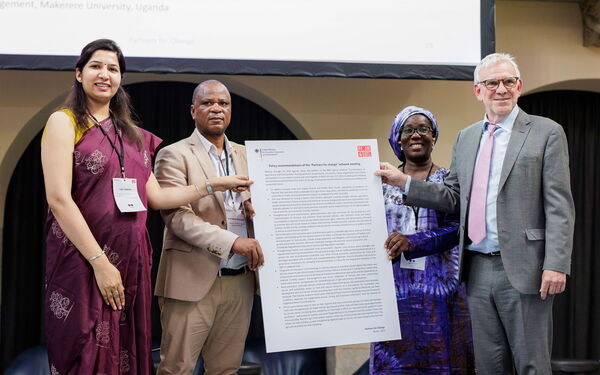
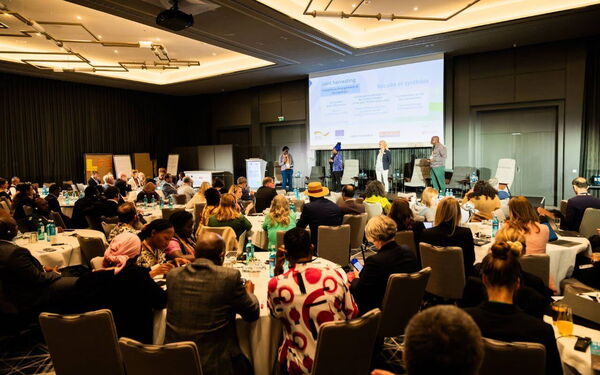
At the network meeting "Partners for change - Transformation to a food secure, resilient and sustainable future", almost 250 participants from over 20 countries came together to exchange experiences and ideas on the transformation of agricultural and food systems. The final product, joint recommendations to transform agricultural and food systems, can now be read online.

This year's network meeting of the Partners for Change (P4C), a network of the German Federal Ministry for Economic Cooperation and Development (BMZ), took place in Nairobi, Kenya, on 26 and 27 June 2024. Kah Walla, moderator of the event and CEO of Strategies!, gives an insight into the key findings and learnings.
Whether in the supermarket or online shop – most of the products we use every day have travelled a long way, which is usually not visible to us consumers. This makes it all the more important to make the people and the conditions under which they work visible. To ensure a healthy and resilient environment, the Supply Chain Act was introduced at EU level - a decisive step towards global fairness. However, this change will only succeed if the economy also takes responsibility. The following six projects show how well this can work. Each of them sets a good example in the respective sector - whether on the topic of gender, climate, health, biodiversity or education. Public institutions and private companies are working hand in hand to achieve concrete improvements for people and the environment along the supply chain.
Do you have questions about the P4C Network
or would you like to contact the P4C Secretariat?
Email us at p4c.secretariat@giz.de.