What it takes now

Artificial intelligence, big data and blockchain are the hottest topics of our time. The digital transformation of the African agricultural sector is ready for take-off. What will it take for the future of technology to hit the ground running?
Ich bin ein Alternativtext
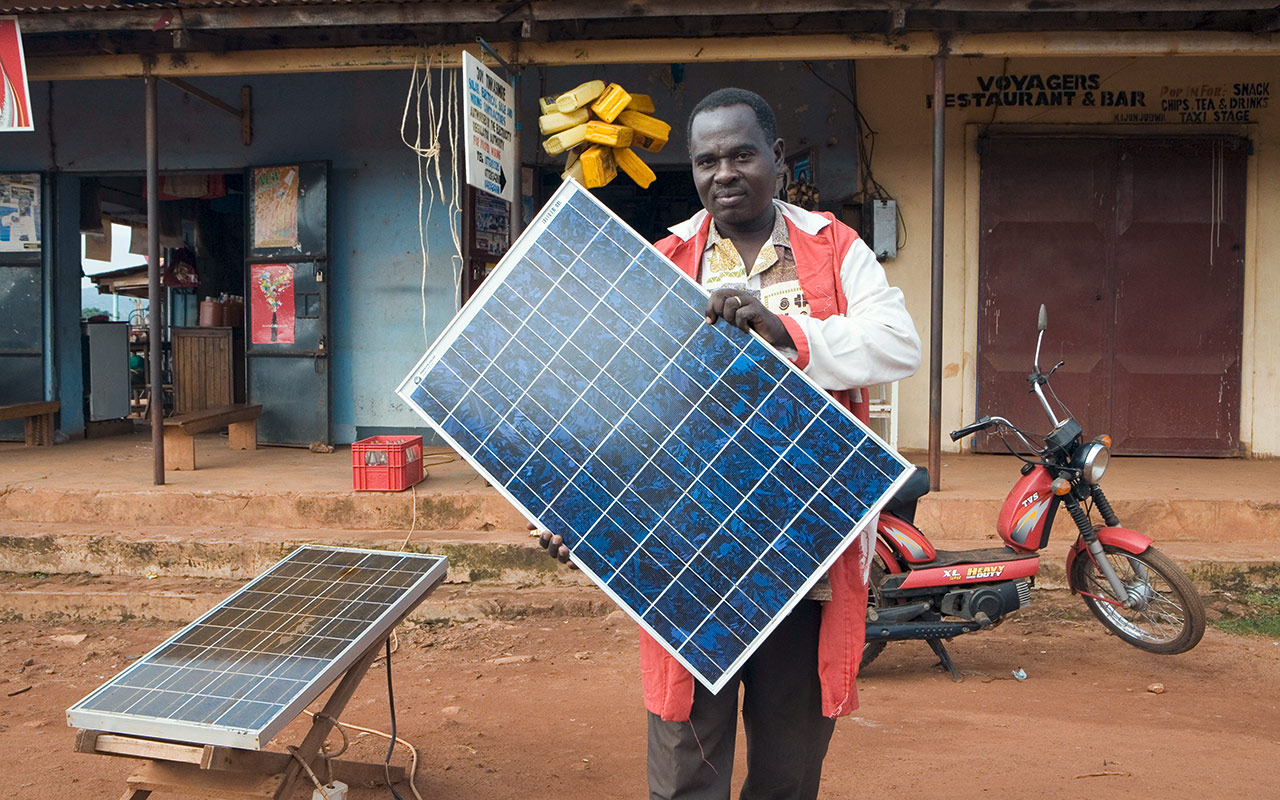
A businessman in Uganda: Here are sold modules for photovoltaics Foto: picture alliance/imageBROKER

By Heike Baumüller

Dr. Heike Baumüller is a Senior Researcher at the Center for Development Research (ZEF), University of Bonn, operates and coordinates the accompanying research for agricultural innovation (PARI).

All contributions

Center for Development Research of the University of Bonn

The potential for digitalization to transform African agriculture has been gaining traction over the past 15 years. Digital technologies are a fast-evolving field and the arrival of each new technology sparks renewed enthusiasm. Starting with mobile phones in the mid-2000s, today the debate has moved on to advanced technologies such as artificial intelligence, big data and blockchains. So is digitalization of smallholder agriculture in Africa indeed becoming a reality? And what does it take for digitalization to take off on a large scale?


Discussions on infrastructure for information and communication technologies (ICT) no longer revolve purely around access. Most people today are covered by 2G networks. Research being undertaken in Nigeria, Ghana and Kenya in the framework of the Program of Accompanying Research for Agricultural Innovation (PARI) has shown that both governments and private sector have played a significant role in expanding and reducing the cost of access. Governments have prepared the ground through policy actions such as liberalizing their licensing regimes for mobile network operators (MNOs), placing requirements on MNOs to share infrastructure, implementing universal access funds or co-financing infrastructure. The private sector took advantage of the spaces created to heavily invest in infrastructure, including sea cables, fibre optic cables and telephone masts.


Current state

As a result, access to mobile phones among end-users is now widespread. However, we still see large discrepancies in terms of quality, stability and speed of mobile networks as well as affordability of ICT services. Indeed, in all three countries, networks are not operating to their full potential and the capacities of sea cables are underused. Last-mile infrastructure that links users to the network remains the main bottleneck, as illustrated by current trends in internet use. Data on internet usage collected by the South African think tank Research ICT Africa mirror those of the early days of the mobile phone, i.e. internet use is more prevalent among young, wealthy, educated, urban male users while urban-rural and gender divides persist. Infrastructure quality and cost are partly to blame for these gaps. The broadband market is still very concentrated which could go some way towards explaining the high costs. Other factors include differences in literacy levels and purchasing power of rural customers, high transaction costs as well as cultural norms that shape the control over mobile phones and household decision-making.
 

Ich bin ein Alternativtext
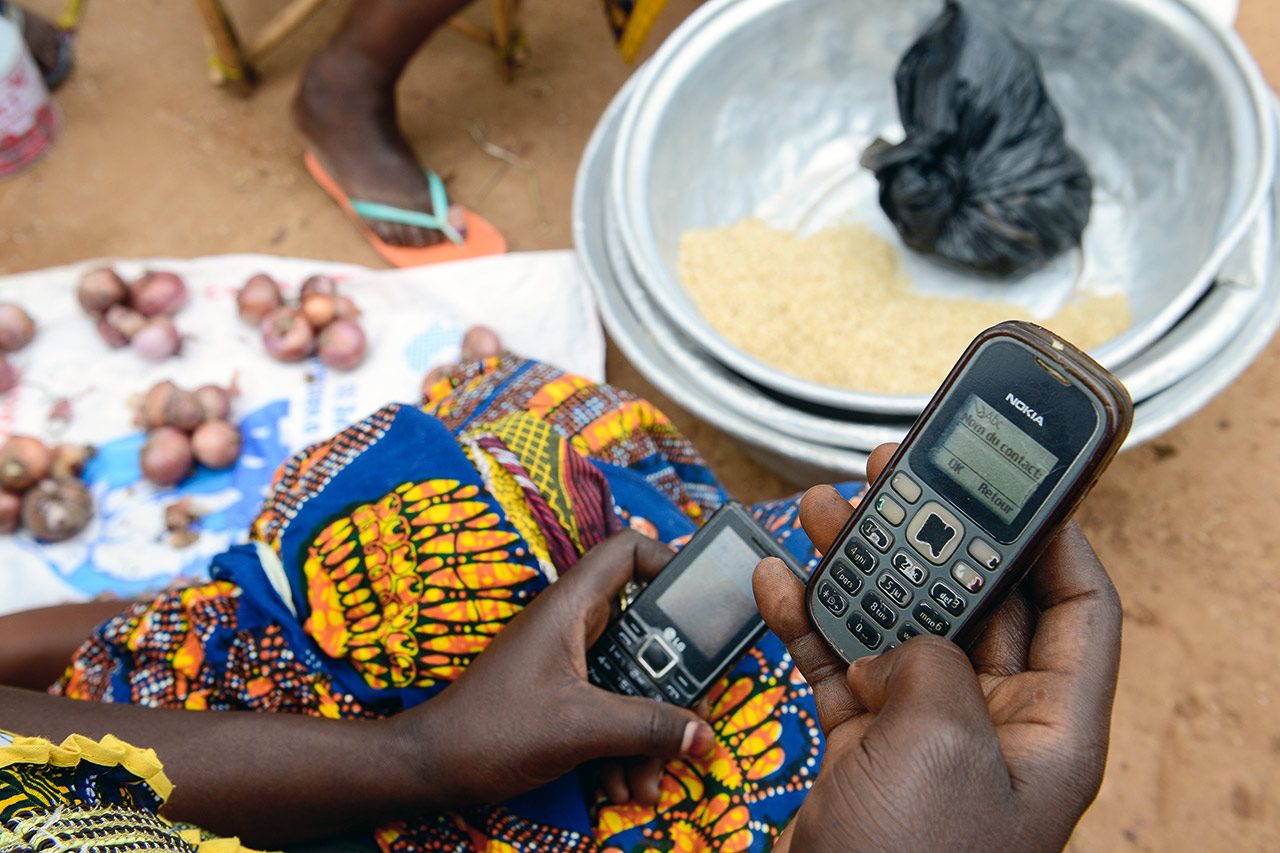
Daily life in Burkina Faso: A rice trader shows her mobile phones. Foto: Jörg Böthling/GIZ

Nevertheless, the rapid expansion of mobile networks even into rural areas has led to a proliferation of ICT-enabled agricultural services (ICT4Ag) in Africa since the late 2000s. In Kenya, Nigeria and Ghana, the expansion was driven by the establishment of innovations hubs that offer a space for start-ups to develop their ideas which they can then pitch to the growing number of ‘angel investors’ or at one of the numerous competitions. In parallel, technical skills of developers improved through new university courses or dedicated training institutes. Kenya is at the forefront of this trend, not least due to the widespread use of mobile money which greatly facilitates the provision of services that require monetary transactions. According to the RIA survey, 83% of Kenyans now use mobile money while the share in Ghana stands at 54%. In contrast, mobile money is not yet used widely in Nigeria, primarily due to regulatory issues that prevent the liberalization of the market.


A review of existing services in the three countries highlights some interesting trends. ICT4Ag services are becoming increasingly complex. Most of them offer multiple services (such as information provision, access to input or output markets, supply chain management or financial services) and address multiple stages of the value chain. While the provision of information still dominates the services on offer, they are now often combined with services that aim to facilitate farmers’ access to markets. ICT-enabled supply chain management tools as well as innovative financial services, such as crowd-funding, are also gaining momentum. However, detailed information on these services is difficult to find, including on pricing, number of users and, importantly, impacts, which makes it difficult to assess their reach and effectiveness.


Anecdotal evidence suggests that most ICT4Ag services remain limited in their scale and struggle to become financially viable. There are several reasons for that. Service providers are affected by existing infrastructure gaps already mentioned above. Access in particular to mid-level finance for service providers also remains an issue. While start-ups can access funding through angel investors and competitions and large business through formal loans, financial resources to enable companies to move from more start-up to medium size are often difficult to obtain.  In addition, most services are mainly target at farmers directly, which on the one hand offers a potentially large market, but on the other hand makes marketing very challenging and costly and limits the sophistication of the services that can be offered.
 

Ich bin ein Alternativtext
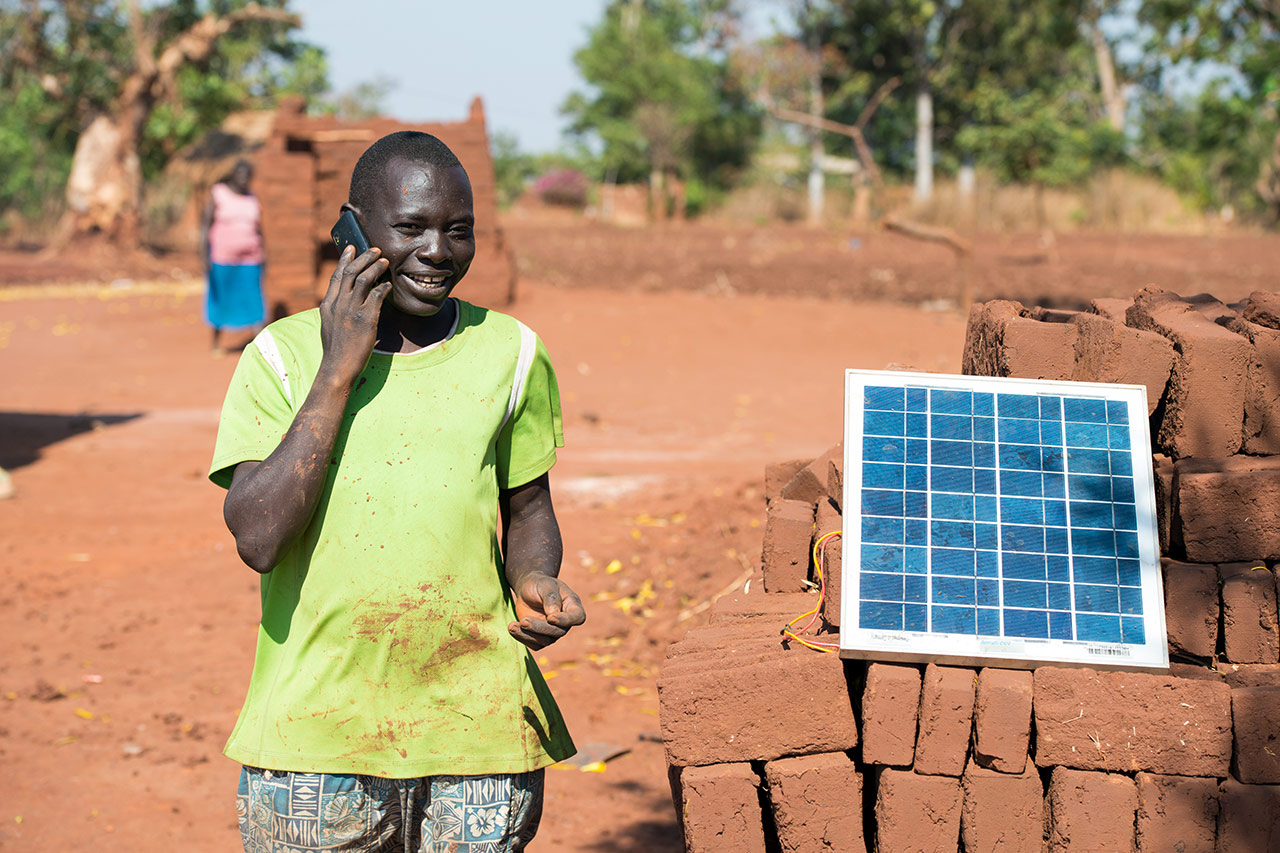
Malawi: The solar array is charging the battery of the mobile phone. Photo: Jörg Böthling/GIZ

Looking ahead: Strategies for advancing digitalization in African agriculture

Invest in rural connectivity, last-mile infrastructure and electricity to enable the widespread use of digital technologies and in particular smartphones.

While smartphone adoption is still relatively low in Africa, in particular in rural areas, it is expected to increase rapidly in the coming years. The GSM Association projects that adoption rates will almost double to reach 67% by 2025 across Africa. Phone companies are increasingly recognizing that low-income countries are the most important growth market for smartphones and are developing lower-cost technologies that cater specifically to that market. Efforts will need to be made to ensure that this does not remain an urban phenomenon among wealthy households.


Take advantage of social media to engage with farmers and the youth.

Social media is driving internet use in Africa, esp. among the youth. According to the RIA data, two thirds of internet users in Kenya and just over half in Ghana and Nigeria are on social media. Similarly, data from the Global Web Index shows that internet users in the three countries spend on average 3 hours a day (or three quarters of their internet time) using social networks and messengers. Thus, social media could be used as an effective channel to engage the youth, disseminate information, facilitate learning among peers, create marketing networks and change the image of agriculture from a subsistence to a business activity.


Integrate ICT4Ag services on digital platforms:

ICT-enabled agricultural services are numerous, disjoint and mostly small. Digital platforms can provide a means to aggregate and integrate these services which can then be accessed through a single interface. Thereby, the different services can complement each other, allowing service providers to specialize rather than trying to solve all issues with one service. Such platforms can also reduce transaction costs for marketing individual services. Importantly, they offer opportunities for quality control of ICT4Ag services to enable users to evaluate which services are in fact effective and best suit their needs.


Provide a start-up friendly business environment.

Such an environment needs to include elements already mentioned above, such as access to mid-level finance, innovation hubs, infrastructure investments and a space for open and fair competition among mobile network operators and ICT-enabled service providers. Additional investments in education will also be key, including mainstreaming ICTs in schools as well as creating dedicated courses as part of vocational training and tertiary education.


Recognize that for digitalization to benefit smallholder farmers, ICT4Ag services do not necessarily need to be targeted at smallholders.

In many instances, farmers can also benefit indirectly, for instance through more efficient supply chains that use ICTs to manage deliveries from smallholder farmers, through better equipped extension agents that use digital technologies to service their farmers, through the use of big data to plan investments in storage, markets and roads, or through more secure land titles documented in blockchain-based land registries.

Similar articles

A smiling farmer carries a tool in a lush green field, while a woman proudly holds a basket of harvested produce.

Ideas on the ground: Local solutions for global challenges

Interview with Sebastian Lesch (BMZ)

A world without hunger and with sufficient healthy food as well as climate-friendly agriculture can only be achieved if ideas are transformed into innovations and ultimately also applied - a conversation with BMZ Head of Division Sebastian Lesch on the Innovation Challenge programme of the new Agricultural Innovation Fund.

Read more

A panel of five speakers engages in a discussion on agriculture, with an audience observing at a conference.

Rethinking funding

By Anna Sophia Rainer

Peasant farmers tend to fail due to bank credit limits. But investment could help them generate a sustainable income. This has given rise to an intense discussion about potential digital solutions.

Read more

Text highlights the potential of 71 million young people to enhance rural areas, with footprints symbolizing progress.

Answers from the youth: "Leave or stay? That depends on it!"

GIZ study; conducted by Geopoll

Does Africa's youth want to live in the city or in the country? Which career path seems particularly attractive? And how optimistic are the young people about the future? Young adults from rural areas answered these questions by SMS.

Read more

A man in a suit and glasses speaks at an International Food Policy Research Institute event.

5 questions to S. Fan: Where are the new roads?

Interview with Shenggen Fan

Shortly before ending his position as Director General of the International Food Policy Research Institute (IFPR) Dr. Shenggen Fan talks about the reforms and new modes of operation needed to achieve global food security in the coming decade.

Read more

A smiling farmer stands proudly in front of a red tractor in a freshly plowed field under a clear blue sky.

How much private investment is the agricultural sector able to bear?

By Pedro Morazán

Small farmers in developing countries must modernise their farming methods, but poorly understood reforms could exacerbate poverty instead of alleviating it.

Read more

Two women in vibrant traditional attire walk joyfully down a street, surrounded by smiling children.

Enough of being poor

By Marcellin Boguy

In western Africa a new middle class is emerging. Their consumer behaviour is determining the demand for products – home-produced and imported goods, on the internet or at the village market. The people of Ivory Coast in particular are looking to the future with optimism.

Read more

Teilnehmer einer Schulung im Digital Transformation Center Kigali, Ruanda. © Mali Lazell, GIZ

Africa's rapid economic transformation

A report by T. S. Jayne, A. Adelaja and R. Mkandawire

Thirty years ago, Africa was synonymous with war, famine and poverty. That narrative is clearly outdated. African living standards are rising remarkably fast. Our authors are convinced that improving education and entrepreneurship will ensure irreversible progress in the region even as it confronts COVID-19.

Read more

A person with curly hair is partially obscured by a large play button icon, suggesting a video is ready to be played.

Video: 4 Questions to Claudia Makdristo

A video clip by Seedstars

Startups are booming in African agriculture. What are the current trend and challenges – and can other regions benefit from innovative approaches? A Video-Interview with Claudia Makadristo, Regional Manager of Seedstars  

Read more

A man stands in a muddy field holding rice plants, addressing a group gathered along the edge.

Turning many into one: CGIAR network restructures

A contribution by Jan Rübel

International agricultural research is responding to new challenges: Their advisory group is undergoing a fundamental reform process and unites knowledge, partnerships and physical assets into OneCGIAR.

Read more

A digital farm scene features a person using a smartphone app to manage crops, with a tractor, drone, and satellite in view.

The digitised farmyard

An interactive graphic Jan Rübel

Lots of apps are entering the market, but what really makes sense? For African agriculture, some of it seems like a gimmick, some like a real step forward. So this is what a smallholder farm in Africa could look like today - with the help of smartphones, internet and electricity. 

Read more

A smartphone screen displays the word "NOTAGER" with a diagonal slash, set against a green and white background.

Story: In Blocked Chains We Trust

A contribution by Solomon King Benge

It is 2080. We are on a farm somewhere in Africa. Everything is digital. The blockchain is an omnipotent point of reference, and the farm is flourishing. But then, everything goes wrong. A dystopian short story, written exclusively for SEWOH.

Read more

A group of people walk through a lush field with tools, while a person is seated on a Powertrac tractor nearby.

"We are not Uber for tractors"

Interview with Jehiel Oliver

Jehiel Oliver was a successful consultant. One day, he quit his job in investment banking to become a social entrepreneur. His mission: tractors for Africa. Rental tractors. What gave him that idea? Find out in his interview with Jan Rübel.

Read more

(c) TMG-SEWOH
Zwei Landwirte führen ein während der COVID-19-Pandemie ein Videotagebuch mit ihren persönlichen Erfahrungen in Umgang mit Corona.

Video diaries in the days of Corona: Voices from the ground

A contribution by Sarah D´haen & Alexander Müller, Louisa Nelle, Bruno St. Jaques, Sarah Kirangu-Wissler and Matteo Lattanzi (TMG)

Young farmers’ insights on the effects of the COVID-19 pandemic on food systems in Sub-Saharan Africa @CovidFoodFuture and video diaries from Nairobi’s informal settlements.

Read more

A gloved hand carefully inspects rows of neatly arranged chocolate bars on a production line.

From start to finish: a vision of interconnectivity

A contribution by Tanja Reith

At the moment, the agricultural industries of African countries exist in relative isolation. Imagine peasant farmers digitally connected to the value chains of the global food industry. How could this happen? A guidebook.

Read more

A man in a checkered shirt uses a smartphone while standing in a lush green field.

A global signpost: What way is the market, please?

A contribution by the World Food Programme

There is a clear global task: We need to feed nine billion people by 2050. We, the people of Earth, must produce more food and waste less. That is the top priority of the UN World Food Programme (WFP), too - the description of a challenge.

Read more

A large audience attentively listens to a speaker on stage during a conference in a well-lit auditorium.

Visions in agriculture

Video by Frank Schultze and Jan Rübel

At the beginning of December 2018, AGRA's board of directors met in Berlin. The "Alliance for a Green Revolution in Africa" ​​panel discussed the next steps in their policy of modernizing agriculture. How to go on in the next ten years? One question - many answers from experts.

Read more

A woman in a vibrant outfit inspects grains at a bustling market stall filled with colorful baskets of produce.

"Nutrition is a human right"

Interview with Joe DeVries (AGRA)

Joe DeVries is a breeder – and Vice President of AGRA (Alliance for a Green Revolution in Africa). What are the chances and risks of a ’green revolution‘ in Africa? A discourse between Jan Rübel and him about productivity, needs, and paternalism.

Read more

A man in a white coat examines labeled seed bags on wooden shelves, showcasing a collection of agricultural samples.

Wanted: German investment in African agriculture

Interview with Stefan Liebing

Stefan Liebing is chairman of the Africa Association of German Business. The manager calls for a better structure of African farms. Jan Rübel asked him about small farmers, the opportunities for German start-ups and a new fund.

Read more

A smiling worker in a green uniform takes notes beside stacked delivery boxes labeled "Bring" in a storage area.

Silicon Valley for Africa’s agricultural start-ups

A contribution by Michel Bernhardt (GIZ)

The project “Scaling digital agriculture innovations through start-ups” (SAIS) supports Africans going into business in the agricultural and food sector in scaling their digital innovations and thus reaching out to a larger number of users.

Read more

A smiling woman wearing a colorful headscarf stands in a sunlit field, exuding joy and confidence.

Africa's face of agriculture is female

A contribution by Beatrice Gakuba (AWAN-AFRIKA)

Africa has a huge opportunity to make agriculture its economic driver. However, the potential for this is far from being made exhaustive use of, one reason being that women face considerable difficulties in their economic activities. The organisation AWAN Afrika seeks to change this state of affairs.

Read more

Two women in traditional attire discuss farming business strategies at a forum, with one holding a microphone.

Innovations for a secure food supply

A contribution by German Agribusiness Alliance

The COVID 19 pandemic is hitting developing and emerging countries and their poorest populations particularly hard. It is important to take countermeasures at an early stage. Companies in the German agricultural sector want to make their contribution to ensuring the availability of urgently needed operating resources.

Read more

A group of children holding pots eagerly wait in line for food distribution outdoors.

Can this end world hunger?

A report by Stig Tanzmann

Time to dig deeper: We can only benefit from technical progress if we have a solid legal framework for everybody. But so far, none is in sight - in many countries. Instead, international corporations grow ever more powerful.

Read more

A man in a red shirt hands cash to a customer through a service window with a sign about mobile money in the background.

News from the starting block: Changeover

A contribution by Michael Brüntrup (DIE)

The region of Sub-Saharan Africa is on the decisive verge of a great development boost in farming: it could skip entire generations of technological development. But how? About possible roles and potentials of digital services.

Read more

A woman presents agricultural produce to a seated group outside, near a house, emphasizing community engagement.

"The Green Revolution reaches its limits"

Interview with Stig Tanzmann (BfdW)

Stig Tanzmann is a farmer and adviser on agricultural issues at ‘Bread for the World’. Jan Rübel interviewed him about his reservations about AGRA's strategy.

Read more

A person speaks passionately at a podium during a presentation at the Ministry for Economic Cooperation and Development.

The communicator

A contribution by Jan Rübel

What do electrical engineering, telecommunications and agriculture have in common? They arouse the passion of Strive Masiyiwa: Thirty years ago, he started an electrical installation company with $75, later riding the telecommunications wave as a pioneer. Today he is committed to transforming African agriculture.

Read more

A man conducts a workshop, engaging an attentive group seated in a classroom setting.

A new attempt at Africa's industrialization?

A contribution by Helmut Asche

Afrika is about ready. There are promising approaches for a sustainable industrialization. However, the path poses challenges to the continent.

Read more

A man in a green robe uses a tablet while standing in a lush field, with another person visible in the background.

Microinsurance against climate change

A contribution by Claudia Voß

Climate change is destroying development progress in many places. The clever interaction of digitalisation and the insurance industry protects affected small farmers.

Read more

Two men in a lush field discuss data sovereignty, holding papers amidst workers gathering crops.

Empowering farmers to control their own data

A contribution by GIZ

A new study on the digitalisation of agriculture puts farmers back at the centre of their own sector, identifies market gaps and gives recommendations on how to support relevant actors.

Read more

Men in a classroom engage with virtual reality headsets for an immersive learning experience.

Cotton of the Future

A Contribution by GIZ

VR glasses are hardly a conventional tool in agriculture: for the past three years, they have been used in rural areas of Burkina Faso and Cameroon as a training tool for sustainable cotton cultivation.

Read more

A woman in a blue sari arranges white silk cocoons on a woven wall in a rural setting.

Gender-Transformative Approaches – Unlocking Everyone’s Potential

A Contribution by GIZ

Studies show that women often manage agricultural resources more effectively and sustainably. With equal access to production resources, agricultural yields could increase by up tp 30 per cent. But this is about more than just productivity. How can gender-transformative approaches (GTA) drive meaningful change and why are GTA key to sustainable change?

Read more

Aerial view of lush green and golden fields separated by a winding dirt path | © Jaum Jovell.

Bringing minds together

A Contribution by Per Brodersen

“In times of global crises and growing budget constraints, strong partnerships are more crucial than ever” – this statement by Federal Minister Alabali-Radovan in the German Bundestag in mid-May is also a guiding principle for the German Agribusiness Alliance. For greater cooperation between politics and the private sector in development cooperation, writes Director Dr. Per Brodersen.

Read more

A man waters plants in a greenhouse while smiling and chatting with a woman, showcasing restoration efforts.

Support for sustainable start-ups

Companies in Africa that need financing between $20,000 and $200,000 find relatively few investors, as this sector is too large for microcredit and too small for institutional investors. This creates a "gap in the middle" where companies have limited options. A project of the World Resource Institute provides a remedy with the Landaccelerator 2020.

A World Resources Institute project

Read more

A graphic illustrates the rapid growth of internet and mobile communication in South Africa from 2000 to 2017.

Africa's digital disruption

Graphics

What Africa is experiencing in the course of digitisation is a disruption. Here three steps are taken in one, there you remain. In any case, the changes are enormous and bring some surprises. A graphic walk.

Read more

Hands display a colorful variety of chillies, including red, green, and orange, showcasing 2023 Black Mamba chillies.

Sandisiwe Dlamini and the chilli pepper business

A portrait by Jan Rübel

By processing chilli peppers, Black Mamba wants to give something back to the rural population. In a short portrait, Sandisiwe Dlamini, Food Safety Officer, reveals how.

Read more

A goat grazes in a lush field near a charming house surrounded by palm trees under a clear sky.

How a Nigerian fintech wants to secure 1 billion US dollars for farms

An Interview with Blessing Mene

Small farmers often have a hard time getting financing. An app in Nigeria wants to change that: Founder Blessing Mene about what his app offers - and about the opportunities and limitations of agricultural financing.

Read more

Handmade signs advertising various services like electrician and hairdresser are attached to a tree trunk.

Mozambique: How informal workers find jobs through an app

A Contribution by Leonie March

There are only about 1 million jobs in the East African country. The majority of the population works in the informal sector, and it can be difficult for them to find customers. Biscate offers a digital solution - without the need for internet, data or smartphones.

Read more

A woman with pink earrings smiles while sitting in a sunny wheat field, under a clear blue sky.

The Answer is Healthy Soil

A Conversation with Nina Mannheimer

The Berlin start-up Klim is forging an alliance between farmers and companies. The aim is to use regenerative farming to remove CO2 from the atmosphere and sequester it as carbon in the soil. An interview with Nina Mannheimer.

Read more

A pile of fresh green coconuts showcases their textured husks and natural imperfections. | © Unsplash

Coconuts, Digitalization and the Future

An Interview with Ebun Feludu

Female founder Ebun Feludu wants to bring the coconut value chain to Nigeria with her start-up Kokari. In this interview, she explains why she envisions every coconut palm tree bearing its own name in the future and how digitalization can contribute to this.

Read more

A person stands joyfully with outstretched arms in a creatively decorated atelier featuring golden accents and various artworks.

From the perennial to the catwalk – banana silk as an alternative

A Contribution by Paul Kadjo

The textile industry contributes significantly to environmental pollution as it produces over 100 billion garments every year, resulting in huge CO2 emissions and water consumption. Fashion designer Paul Kadjo uses banana silk as an environmentally friendly alternative to make textile production more environmentally conscious and socially just.

Read more

A person in a blue sleeve harvests ripe coffee cherries from a vibrant coffee plant.

The Idea of Coffee entirely made by Women

A Conversation with Allan Mubiru

Allan Mubiru was standing in front of a shelf in Kigali, Rwanda, and discovered a local type of coffee. He took it, tasted it and was thrilled. A story about a grocery shopping trip that became the beginning of a successful business idea.

Read more

A woman at a trade show proudly displays organic food products in front of a booth showcasing diverse packaged goods.

BIOFACH as a game changer for organic producers

A Contribution by Claudia Jordan

In 2025, GIZ and the Import Promotion Desk (IPD) celebrate ten years of successful cooperation. With their joint stand at BIOFACH trade fair in Nuremberg, they were able to introduce over 300 organic companies of partner countries to the European market. And the journey continues – despite challenges on the global market.

Read more

A group of five smiling individuals stands in a bakery, showcasing freshly baked goods on metal racks.

With the power of fried bread

A contribution of Jan Rübel and Fabio Rappenecker

With a simple but effective idea to combat malnutrition: in Nairobi, Fabio Rappenecker and his start-up TenX Nutrition produce mandazi, which become a real power biscuit thanks to added micronutrients. The aim is to strengthen food security through local, affordable and healthy food.

Read more

Three workers in protective gear are handling soil and shovels at a sanitation site, focusing on waste management.

No dirty dealing

Von Marlis Lindecke

Shit Business is Serious Business: A successful cooperation between research and the private sector.

Read more

A man in a suit sits at a table with colorful artworks on the wall behind him, creating a professional front page image.

Slaves do not produce quality

By Tilman Wörtz

Every child in Germany knows Ritter Sport – but most of the children harvesting cocoa on western African plantations have never even eaten chocolate. Can a chocolate manufacturer change the world? Conversation with Alfred Ritter about the power and powerlessness of a businessman.

Read more

A lively panel discussion unfolds with a speaker gesturing energetically while others sit, including L. Hartmann, smiling.

A fresh opportunity

Interview with Lutz Hartmann

By leasing a three hundred hectare fruit plantation in Ethiopia, Lutz Hartmann has realised a long-cherished dream: to run his own business in Africa. Now he has a personal interest in the issue of Africa’s development.

Read more

A hand carefully opens a ripe cocoa pod, revealing the seeds inside against a backdrop of more pods.

Doing More With Less

A contribution by Jochen Moninger

Innovation is the only way to end hunger worldwide by the deadline we have set ourselves. The secret lies in networking and sharing ideas – and several initiatives are already leading by example.

Read more

A drone sprays pesticide over lush green tea plantations on a sunny hillside.

Pesticides – a blessing or a curse?

A debate between Lena Luig and Ludger Weß

What are the consequences of using synthetic pesticides in agriculture? Where do they help, where do they harm? Lena Luig, expert for the development policy organization INKOTA, and science journalist Ludger Weß discuss this controversial topic of international scope.

Read more

Vibrant scene in Abidjan market with vendors balancing colorful fruits and vegetables on trays amid bustling crowds.
Food market in Abidjan. © GIZ

Reference values: A building block on the road to social equality

A contribution by Friederieke Martin (GIZ)

A quick and cost-effective method calculates living wages and incomes for many different countries. The GIZ together with Fairtrade International and Richard and Martha Anker have developed a tool that companies can use to easily analyse income and wage gaps.

Read more

A farmer walks through lush coffee plants on a misty morning, carrying a basket for harvesting.

Ms Rudloff, what are the benefits of a supply chain law?

By Jan Rübel

The Federal Government is fine-tuning a law that would require companies to ensure human rights – a supply chain law. What are the consequences for the agricultural sector? Dr Bettina Rudloff from the German Institute for International and Security Affairs (SWP) discusses linking policy fields with added value.

Read more

Workers in uniforms and masks sort nuts in a processing facility, showcasing a clean and organized environment.

Freed from trade? Towards a fairer EU Trade Agenda

A contribution by Dr. Jan Orbie (University Gent)

‘Fair’ and ‘sustainable’ are key words in Germany’s EU Council Presidency. At the same time, Germany pursues ‘modernization’ of the WTO and ‘rapid progress’ on free trade agreements. Are these goals really compatible? Can we be concerned about fairness and sustainability while continuing with ‘business as usual’?

Read more

(c) Christoph Püschner/Diakonie Katastrophenhilfe
Republik Niger / Kollo, Nov. 2017: Müttern haben sich für den Vortrag "richtige Ernährung für Kinder" der NGO Kundji Fondo im Dorfzentrum versammelt.

Good health is impossible without healthy food

A contribution by Heino von Meyer

Corona makes it even more difficult to achieve a world without hunger by 2030. So that this perspective does not get out of sight, Germany must play a stronger role internationally - a summary of the Strategic Advisory Group of SEWOH.

Read more

A person stands on a rocky hill, overlooking a vast, scenic landscape with a towering cliff and expansive fields below.

Human Rights, Land and Rural Development

A contribution by Michael Windfuhr (German Institute for Human Rights)

Land rights are no longer governed by the law of the strongest. That is what the international community has agreed to. Governments and private companies have a duty to respect human rights and avoid corruption.

Read more

Farmers operate a blue and red tractor tilling dry soil in a dusty field under clear skies.

Continent in an uptrend

A report by Dr. Agnes Kalibata (AGRA)

Partnering for Africa’s Century: Innovation and Leadership as Drivers of Growth and Productivity in Rural Areas

Read more

A woman in a vibrant purple dress sits smiling beside an intricately carved wooden sculpture.

Small Farms, big money

A contribution by Agnes Kalibata

Agnes Kalibata, AGRA president since 2014 and former minister of agriculture and wildlife in Rwanda, is convinced that Africa's economy will only grow sustainably if small-scale agriculture is also seen as an opportunity.

Read more

Women joyfully sell tomatoes and vegetables at a vibrant market stall, highlighted by a striking red and blue overlay.

How can the private sector prevent food loss and waste?

An interview with David Brand (GIZ)

From a circular food system in Rwanda to functioning cooled transports in Kenya: The lab of tomorrow addresses development challenges such as preventing food loss and waste

Read more

A person harvests plants next to a branded sack in a field, emphasizing sustainable farming practices.

From lost products to safe food - Innovations from Zambia

A contribution by GIZ

In Zambia, innovative approaches are used to address the problem of post-harvest losses in the groundnut value chain. GIZ's Rapid Loss Appraisal Tool (RLAT) can help to develop more such approaches.

Read more

A woman tends to lush green plants in a field at sunset, embodying sustainable agriculture.

Investing in Healthy Soils: Curse or Blessing?

A Contribution by WWF

How investing in healthy soils provides incentives for more sustainable agriculture even as it demonstrates the need for far reaching changes in the agrisector.

Read more

Farmers plow a field with oxen under tall palm trees, preparing for cultivation.

Successful Blueprints for African Agriculture

A Contribution by GIZ

At the 8th German-African Agribusiness Forum (GAAF) representatives from business and politics discussed successful investment models to improve living conditions in Africa.

Read more

Infographic illustrating key criteria for agribusiness partnerships, including climate adaptation and sustainable production.

Together towards Sustainable Development: Private Sector Cooperation

A Multimedia-Toolbox by GIZ

Achieving the Sustainable Development Goals through responsible investments in the agri-food sector of emerging countries.

Read more

©GaÎl GellÈ
Cote d'Ivoire

Controversy: Do supply chains need liability rules?

Discussion about the potential supply chain law

The German government is struggling to pass a supply chain law. It is intended to address violations of human rights, social and environmental standards. What would the consequences be for business? A double interview with Veselina Vasileva from GEPA and economics professor Andreas Freytag.

Read more

Four individuals stand smiling at the Food Systems Pavilion during the COP27 event in Egypt, 2022.

G7 Sustainable Supply Chains Initiative: From Commitment to Action

Future generations need more sustainable and stable agri-food systems. But how can this comprehensive transformation succeed and what responsibility does the private sector bear? These questions were the focus of the G7 Sustainable Supply Chains Initiative (G7 SSCI) side event as part of the ‘Champion Youth Action’ day at the 27th UN Climate Change Conference (COP27).

Read more

A woman sorts cocoa beans in a wooden tray, wearing a colorful floral shirt and traditional patterned skirt.

"We didn't even make it halfway"

Interview with Claudia Brück and Torben Erbrath

The demand for fair-trade cocoa is growing – but how is the industry responding? In an interview, Claudia Brück, Executive Board Member of Fairtrade Germany, and Dr. Torben Erbrath, Managing Director of the Federal Association of the German Confectionery Industry, discuss progress as well as challenges, and why real change can only be achieved through long-term commitment along the entire supply chain.

Read more

A man collects natural rubber from a tree, holding a container and tapping tool in a lush forest. | © GIZ

From the Tree to the Street: The Story of Natural Rubber

A Contribution by Carlos Castellanos & Yvonne Bielfeld

The shoe manufacturer Cueros Vélez as a good example of private sector responsibility: the photo gallery shows how the bark of the rubber tree becomes a reliable yet deforestation free companion on our roads.

Read more

Illustrated icons highlight six collaborations aimed at creating fair and sustainable supply chains.

Stronger toghether: Six collaborations for fair agricultural supply chains

A Listicle by Yvonne Bielfeld

For everyone in the supply chain to benefit, it is essential that politics and business work together. The measurable successes of such partnerships are demonstrated by the following six projects: they show how cooperation with the business sector can make supply chains fairer, more resilient, and more sustainable step by step.

Read more

Stephan Exo-Kreischer ist Deutschland-Direktor der Lobby- und Kampagnenorganisation ONE.

New campaign for women: "Poverty is sexist"

Interview with Stephan Exo-Kreischer

This is a benchmark for everybody: More rights for women are a very influencing solution in the struggle against extreme poverty and hunger worldwide, says Stephan Exo-Kreischer, Director of ONE Germany. The organisation specialises in political campaigning as a lever for sustainable change.

Read more

A person holds a smartphone displaying the Maano virtual farmers' market app, with two people smiling in the background.

Ebay Against Hunger - How an App Supports Crop Sale of Rural Small Holders in Zambia

Small holders around the world are often forced to sell their harvests below market value due to a lack of market and pricing information. A new app by the UN World Food Programme (WFP) is going to change this.

A project of WFP

Read more