Newsletter
Don't miss a thing!
We regularly provide you with the most important news, articles, topics, projects and ideas for One World – No Hunger.
Newsletter
Don't miss a thing!
We regularly provide you with the most important news, articles, topics, projects and ideas for One World – No Hunger.
Please also refer to our data protection declaration.
Successful transformation often begins not with large-scale programmes, but with viable decisions at the local level. The example of Julienne, a soybean processor in southern Benin, illustrates how entrepreneurial knowledge, realistic investment planning, and access to tailored agricultural finance can work together. Her step-by-step growth makes visible the conditions under which financing does not create dependency, but becomes an instrument of sustainable value creation. In this way, the case points beyond the individual story to broader structural questions of agrifood systems transformation.

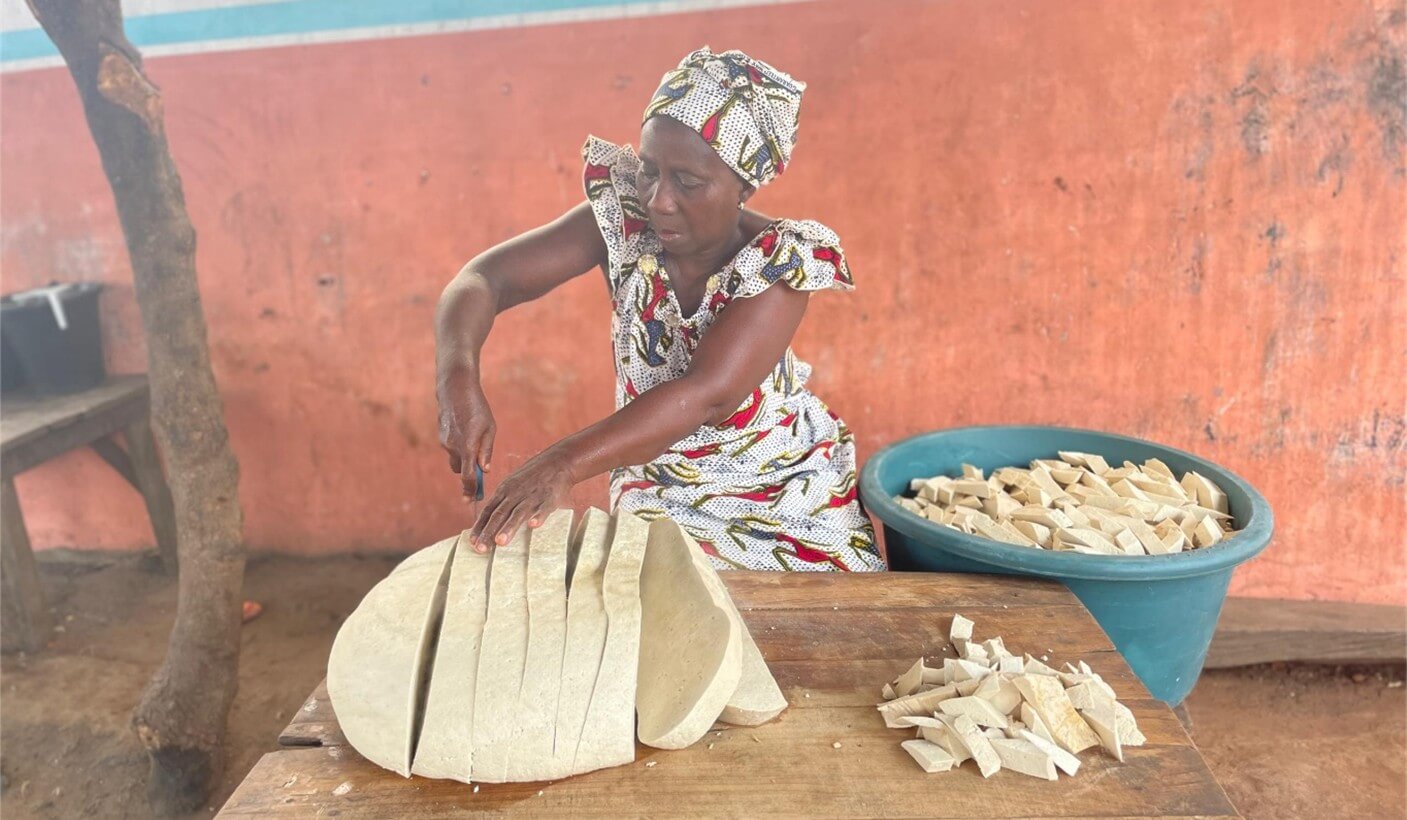
In Zakpota, in southern Benin, Julienne processes soybeans into tofu. When she took part in a training on basic business analysis and investment planning in 2018, she began to look at her production more systematically: which costs arise at which stage, when an investment is worthwhile, and under what conditions it can be repaid.
Based on this assessment, she took out a small loan from her cooperative bank, RENACA, and invested in her first mill. This collaboration was possible because both Julienne and the bank developed a shared understanding of how income, processing capacity, credit-financed investments, and repayment are connected.
Seven years later, her business has changed significantly. Julienne has fully and punctually repaid her first loan as well as two subsequent ones and currently requires no further credit financing. She is now able to build up stock from her own resources and owns two mills. She has increased her processing capacity from six to 100 kilograms per day through her ongoing operations and employs up to eight women from her community, enabling them to earn an income close to where they live. Her development has been gradual, aligned with local market opportunities, based on a viable business model, and independent of subsidies.
“Before, I had to buy soybeans on credit. Today, I have my own stocks – and I can supply others,” Julienne says.
An approach with a long-term perspective
Commissioned by the German Federal Ministry for Economic Cooperation and Development (BMZ), the GIZ global programme “Promoting Agricultural Finance for Agribusinesses in Rural Areas” works in nine countries in sub-Saharan Africa to make investment decisions and lending more transparent and predictable. For agricultural enterprises, this means understanding their activities as entrepreneurial undertakings and being better able to justify investment decisions. Financial institutions, in turn, learn to assess business models in the agricultural sector more realistically and to better evaluate risks.
Importantly, the programme does not provide financial resources. Loan financing comes from the existing capital of local financial institutions. When processes, risks, and potential become transparent on both sides, private capital can flow to where value creation takes place. Experiences from Benin show that businesses grow through their own efforts, banks build sector-specific expertise in agriculture, and income is generated where people live and produce. Such developments are crucial, as the agricultural sector remains the primary source of income and employment in many countries in sub-Saharan Africa and thus a key lever for stable rural economies.
A contribution to the transformation of agrifood systems
International debates on the transformation of agrifood systems emphasize the importance of investing in productive, socially and environmentally sustainable value creation. Designing such investments responsibly and enabling them where transformation actually occurs remains a central challenge. The example from Zakpota points to one pathway: financing becomes sustainable when knowledge is shared, risks are reduced, and local capacities are strengthened. In this way, development emerges that is gradual, realistic, and durable in its impact.
Global Programme “Promoting Agricultural Finance for Agribusinesses in Rural Areas”
In addition to Julienne, more than 95,000 producers in Benin have completed training in financial literacy. Nearly half of the participants are women (48 percent), and 37 percent are young people. Across the nine partner countries of the global programme, a total of 244,000 producers have taken part in the trainings, including 49 percent women and 35 percent youth. The partner countries are Benin, Zambia, Nigeria, Cameroon, Mali, Burkina Faso, Malawi, and Togo.
Programme duration: 2016–2027
Further information on the programme and on Julienne is available here.

Read more Is the international community still on track in the fight against hunger?


Read more Resilient small-scale agriculture: A key in global crises

Read more One Health – What we are learning from the Corona crisis

Read more The state of food security in Cape Town and St. Helena Bay

Read more School Feeding: A unique platform to address gender inequalities

Read more Success story allotment garden: Food supply and women's empowerment


Read more Planetary Health: Recommendations for a Post-Pandemic World

Read more This is how developing countries can adapt better to droughts

Read more How can the private sector prevent food loss and waste?

Read more Food System Transformation Starts and Ends with Diversity

Read more Building Better Resilience to Transboundary Threats

Read more Building climate-resilient and equitable food systems: Why we need agroecology

Read more How are transformation and crisis intervention related, Dr. Frick?

Read more 5 Questions for Jann Lay: What is Corona doing to the economy?

Read more Agricultural prices and food security – a complex relationship

Read more What is needed for a long-term fertiliser strategy?

Read more From Pledges to Progress: Nutrition at the Heart of Inclusive Development

Read more Financing Agrifood Systems for People, Planet and Prosperity


Read more Reference values: A building block on the road to social equality

Read more How the self-help approach empowers smallholder women

Read more Gender equality: Essential for food and nutrition security

Read more The rush for green energy shouldn’t undermine rights of pastoralist communities

Read more Female Leadership: A Key Lever for Transformation?

Read more Gender-Transformative Approaches – Unlocking Everyone’s Potential

Read more "We have high expectations of the Kampala Declaration"

Read more From the Tree to the Street: The Story of Natural Rubber

Read more Stronger toghether: Six collaborations for fair agricultural supply chains

Read more A political opportunity to overcome structural barriers for women farmers

Read more Food Systems, Law, and Social Inclusion: Reflections from Kenya

Read more "The Agri-Sector is a Space of Opportunity and Entrepreneurship"