Newsletter
Don't miss a thing!
We regularly provide you with the most important news, articles, topics, projects and ideas for One World – No Hunger.
Newsletter
Don't miss a thing!
We regularly provide you with the most important news, articles, topics, projects and ideas for One World – No Hunger.
Please also refer to our data protection declaration.
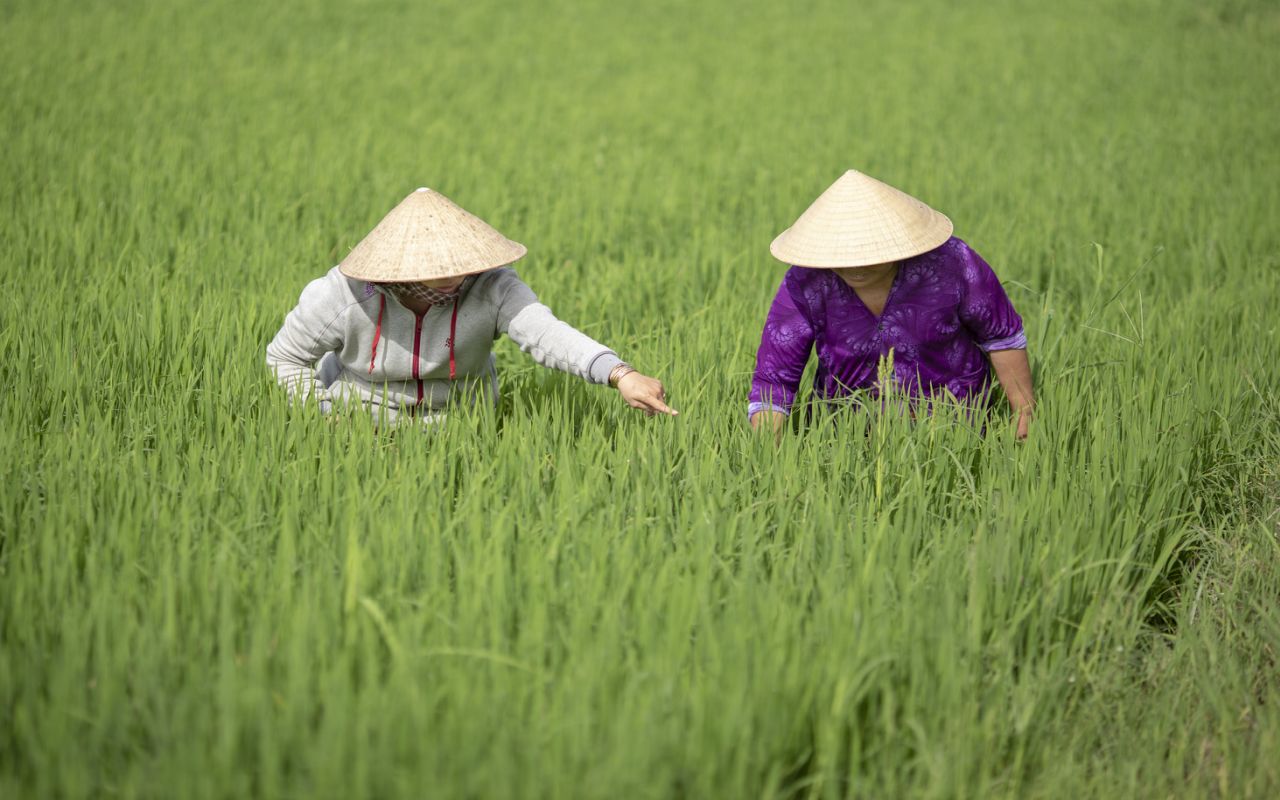
The International Year of the Woman Farmer (IYWF), launched by the United Nations for 2026, is more than a symbolic moment. It is a political opportunity – and responsibility – for German development cooperation. This is what the Federal Ministry for Economic Cooperation and Development (BMZ) emphasised during Grüne Woche trade fair in Berlin.

During the Global Forum for Food and Agriculture (GFFA) and Grüne Woche 2026 in January, the International Year of the Woman Farmer was one of the key topics. Not only right after the opening of the BMZ booth of the trade fair, even during a high-level Networking Event hosted by Deutsche Gesellschaft für Internationale Zusammenarbeit (GIZ) GmbH, the launch of this special year has been celebrated and discussed.
During the panel at the BMZ booth titled “Strong Women. Strong Agriculture. 2026, the International Year of the Woman Farmer”, Parliamentary State Secretary Dr Bärbel Kofler discussed with partners the crucial role female farmers play for agricultural and food systems. Indeed, only 15 percent of women worldwide own land, emphasised Kofler. Despite their contributions and hard work in the agricultural and food sector.
Men are not competitors to women, but companions and women should work with them when it comes to their rights and representation, emphasised Nkoloka Halwindi, founder of Nkoka Women in Agro-Business (NWAB) in Zambia. The farmers’ organisation has around 6,000 members. It is supported by the Andreas Hermes Akademie (AHA) in organisational development. AHA is partner of the GIZ Global Programme Strengthening Farmers' Organisations for Sustainable Agricultural Development. The programme strongly supports young and female farmers in strengthening their leadership and advocacy skills. And there is still a lot to lobby for when it comes to women’s interests, Nkoloka Halwindi knows: She describes financing as a major barrier for women in agriculture.
In Germany, too, women face structural hurdles in the agricultural and food sector, added Christine Reitelshöfer, Second Vice President of the German Rural Women (dlv). They lack access to land and heritage and often are still not part of the decision-making.
This is why the rights, resources and representation of rural women remain crucial, Dr Kofler summarised.
The GIZ project “Feminist Approaches to Resilient Agriculture and Food Systems (FemHub)” on behalf of BMZ had also invited partners to a networking event on the IYWF during the trade fair. Dr Andreas Schaumayer, Head of Division for Food Security and Fisheries at BMZ, stated in his opening speech: “Women are essential to agricultural production, food security and rural livelihoods.” However, women continued to face persistent barriers, he said: unequal access to land and inheritance, limited access to finance and services, restricted participation in decision-making and leadership, and a disproportionate burden of unpaid care work.
“These barriers are not marginal – they are structural”, Dr Schaumayer stated. They limited not only women’s rights and opportunities, but also the resilience, sustainability and productivity of agriculture and food systems as a whole. “This is why the International Year of the Woman Farmer is more than a symbolic moment. It is a political opportunity to sharpen focus, mobilise alliances and push for concrete and lasting change”, Dr Schaumayer underlined.
BMZ just a few days before the event had launched its new reform plan “Shaping the future together globally“, emphasising that feminist policy remains a priority for German development cooperation. “In agricultural and food systems, this translates into gender-responsive policies, investments in women’s economic empowerment, stronger women’s organisations and cooperation to address structural barriers at national and international levels”, Schaumayer explained.
During the event, Tacko Ndiaye, Gender team lead of the Rural Transformation and Gender Equality Division at the Food and Agriculture Organisation (FAO), invited participants to join forces and engagement during the year. When women were empowered, they could enhance the well-being of their families and communities, she said during her presentation. Women could furthermore reduce hunger, improve dietary diversity and nutrition, boost incomes and economies and finally strengthen the resilience of households to shocks.
She presented the vision of the IYWF that FAO launched in December:
“A world where women farmers, in all their diversity, are fully recognized, supported and empowered with equal rights, resources, and decision-making power to drive food security, nutrition, poverty reduction, and resilient, sustainable agrifood systems”.
She outlined that during the year, FAO and partners want to raise awareness of the crucial role women farmers play in agricultural and food systems. It wants to highlight actions that can help close the gender gaps. Finally, the year should channel policy making, programming and increased investment.
Elizabeth Nsimadala, president of the Eastern Africa Farmers Federation (EAFF), embraced the celebration of women throughout the year. Women are key pillars of families, communities and societies and needed to be seen, she said. She appreciated the support of GIZ and AHA in strenghening her farmers organisation and that regional and global decision-making platforms and fora give women farmers and their organisations the space to address their issues. She called for collective empowerment and shared responsibility across genders.
Young female farmer Gugulethu Mahlangu from South Africa stated during a panel discussion, that despite many challenges especially for agripreneurs like her, she sees agriculture as a career, having built her own business she proudly presented. She is founder of House Harvest (Pty) Ltd, an enterprise integrating fish farming, indigenous crops, insect protein and renewable energy. Gugulethu is furthermore Vice President of the Youth Leadership Incubation Programme (YLIP) 2025 of the Southern African Confederation of Agricultural Unions (SACAU). The programme implemented with the AHA strengthens youth leadership in regional farmers’ organisations. Gugulethu’s work there focuses on innovation, food security, and just transition pathways in Southern Africa.
Law student Camara Castro, Assistant Project Coordinator of the AMKA Africa Justice Initiative in Kenya, gave some insights on his work providing legal information to women. He focuses on access to justice, women’s land rights and legal empowerment in agricultural and rural contexts. He emphasised that women needed information on their rights and certain laws to self-empower. “Justice goes beyond law”, he stated, underscoring the importance of addressing the broader social and structural context.
Christina Arkenberg of UN Women Germany sees the IYWF as a chance for urgent reforms in women’s land rights, resources and social protection. She highlighted the impact of climate change for women and their need for financial support to become climate actors. During the year, it would be important to have a look at bottom-up initiatives, too, she said. A lot on the list for a very special year to come. The journey of the IYWF2026 just has begun.
By Claudia Jordan

Read more Is the international community still on track in the fight against hunger?

Read more Global responsibility: Tackling hunger is the only way forward

Read more Biodiversity and agriculture – rivalry or a new friendship?
Read more Mr. Marí, what happened at the alternative summit?
Read more What is wrong with our nutrition in Germany, Mr. Plagge ?

Read more How Can We Feed The World in Times of Climate Change?
Read more Nine Harvests Left until 2030: How Will the BMZ Organise Itself in the Future?
Read more Cooperation and Effective Incentives for Sustainable Land Use

Read more What Needs to Change for Africa’s Youth, Ms Kah Walla?

Read more How to Enhance Soil Organic Carbon – Uniting Traditional and Innovative Practices
Read more Digitalization: The Driving Force in the Future of Agriculture?

Read more Our Food Systems are in Urgent Need of Crisis-Proofing: what needs to be done

Read more "Human capital will play a pivotal role in the transformation of African economies"

Read more The importance of water for sustainable rural development

Read more New legal initiatives towards deforestation-free supply chains as a game changer

Read more 2022, a year of crisis – What does it mean for African trade and food security?
Read more How the War against Ukraine Destabilizes Global Grain Markets

Read more Controversy: Do supply chains need liability rules?

Read more 5 Questions for Jann Lay: What is Corona doing to the economy?

Read more Sustainable, feminist and socially just: The new Africa strategy of the BMZ

Read more Do import restrictions really benefit the local poor in West Africa?

Read more Sang'alo Institute invests in farming of sunflower crop

Read more Farmers' organizations want to be involved in designing agricultural policy

Read more BMZ releases video on the transformation of agricultural and food systems

Read more “More of the same is not enough - we need to rethink”

Read more Partners for change - Network meeting on transforming agricultural and food systems

Read more What is needed for a long-term fertiliser strategy?

Read more A framework for sustainable and fair agriculture and food systems

Read more Female Leadership: A Key Lever for Transformation?

Read more Gender-Transformative Approaches – Unlocking Everyone’s Potential

Read more Adapted financial services – a key to transformation

Read more From Pledges to Progress: Nutrition at the Heart of Inclusive Development

Read more Bundled Knowledge – The Compendium of the Green Innovation Centers

Read more „Young people tend to be on that curve of early adopter“

Read more “I feel the weight of hundreds of millions of farmers”


Read more Reference values: A building block on the road to social equality

Read more How the self-help approach empowers smallholder women

Read more School Feeding: A unique platform to address gender inequalities

Read more Gender equality: Essential for food and nutrition security

Read more Success story allotment garden: Food supply and women's empowerment

Read more Planetary Health: Recommendations for a Post-Pandemic World

Read more The rush for green energy shouldn’t undermine rights of pastoralist communities

Read more "We have high expectations of the Kampala Declaration"

Read more From the Tree to the Street: The Story of Natural Rubber

Read more Stronger toghether: Six collaborations for fair agricultural supply chains

Read more Food Systems, Law, and Social Inclusion: Reflections from Kenya

Read more "The Agri-Sector is a Space of Opportunity and Entrepreneurship"

Read more Digital participation in the agrofinance sector: rural development and women's inclusion

Read more Towards Climate Justice: Securing Women’s Land Rights for a Resilient Tomorrow