


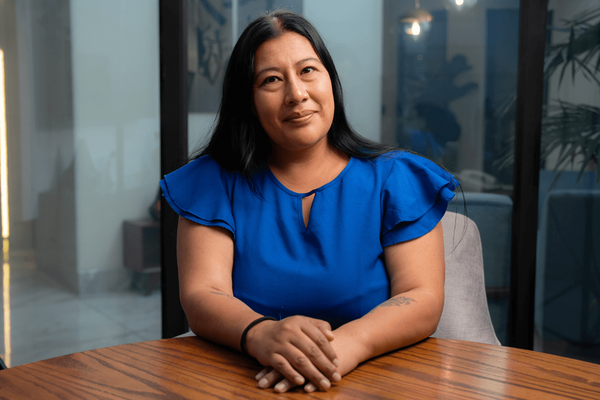
Leidy: Coffee producer who creates opportunities for women and young people
For young women coffee producers like Leidy, collaboration between cooperatives and development projects opens new opportunities along the entire value chain. Through her involvement in the “Notas de juventud” coffee line, she gains not only technical expertise but also greater economic independence and visibility.


Leidy Tatiana Fierro is a young coffee farmer from Huila, Colombia. She gets up early when the sky is still dark blue and is the mother of two children. When she was young, economic barriers closed the door to formal education and she had to start working at a very young age. Today, her coffee farming has opened another door for her: it is an opportunity and a livelihood for her, her husband and her children.
“Being a farmer means being able to be independent, to have my own business, to be able to train continuously in coffee, which is what I am passionate about.”
On her farm, she organises her time between home, farming and training. She describes her main challenge directly:
“The most common thing you face is a lack of time for everything ... but we women can do anything, it's just a matter of organising ourselves well”.
She mentions that in addition to housework and caring for the family, women in the region are a fundamental pillar for improving production, organisation and diversification, which increases sustainability and contributes to family support and the market. When she thinks of the women farmers, she has a clear idea: “It gives me great joy to know that there are more women who are dedicated, passionate about agriculture, enterprising, who sometimes with difficulties always give their best”. Her experience confirms that promotion and training are key to closing gender gaps. She started attending workshops, gained confidence, learned to add value to her product and to promote projects that include more women. With the support of her family and discipline, she achieved a relevant certification: she is an Evolved Q Grader – an internationally recognized coffee tester.

Leidy is part of the coffee line “Notas de juventud” of the COOCENTRAL cooperative. The launch was supported by the AgriChains project of Deutsche Gesellschaft für Internationale Zusammenarbeit (GIZ) GmbH with funding from the German Federal Ministry for Economic Cooperation and Development (BMZ). For her, the result is concrete: “This project between the Cooperative and the GIZ is a unique experience, it has been a great support for young people. The 'Youth Notes' brand has been amazing”.
Looking ahead to the next 5-10 years, she identifies priorities: opening up more opportunities, continuing training and maintaining technical updates. Her personal goal is to support more women from her experience as a certified producer and cupper, to empower them and make them more visible throughout the coffee chain. Her plan is practical: to share knowledge, promote training and connect producers with initiatives and markets.
Leidy is a participant in the global programme “AgriChains”, which is implemented by the Deutsche Gesellschaft für Internationale Zusammenarbeit (GIZ) GmbH with funding from the German Federal Ministry for Economic Cooperation and Development (BMZ). She says of this programme: “We not only improve the quality of life in terms of sustainability and installed capacities, but also in economic terms”.
A Contribution by Carlos Castellanos Neira
Related articles

Farming Hopes: Haribati's Journey of Empowerment and Resilience
Read more Farming Hopes: Haribati's Journey of Empowerment and Resilience


From pond to plate – how aquaculture leverages women empowerment in Myanmar
Read more From pond to plate – how aquaculture leverages women empowerment in Myanmar


Sowing Seeds of Leadership: Ahalya Sahu’s Journey in Natural Farming
Read more Sowing Seeds of Leadership: Ahalya Sahu’s Journey in Natural Farming

Kristina Rampang: A Mother, A Farmer, A Community leader
Read more Kristina Rampang: A Mother, A Farmer, A Community leader

Cultivating Resilience in Times of Climate Change: Madam Racheal’s Journey in Soy Farming
Read more Cultivating Resilience in Times of Climate Change: Madam Racheal’s Journey in Soy Farming


