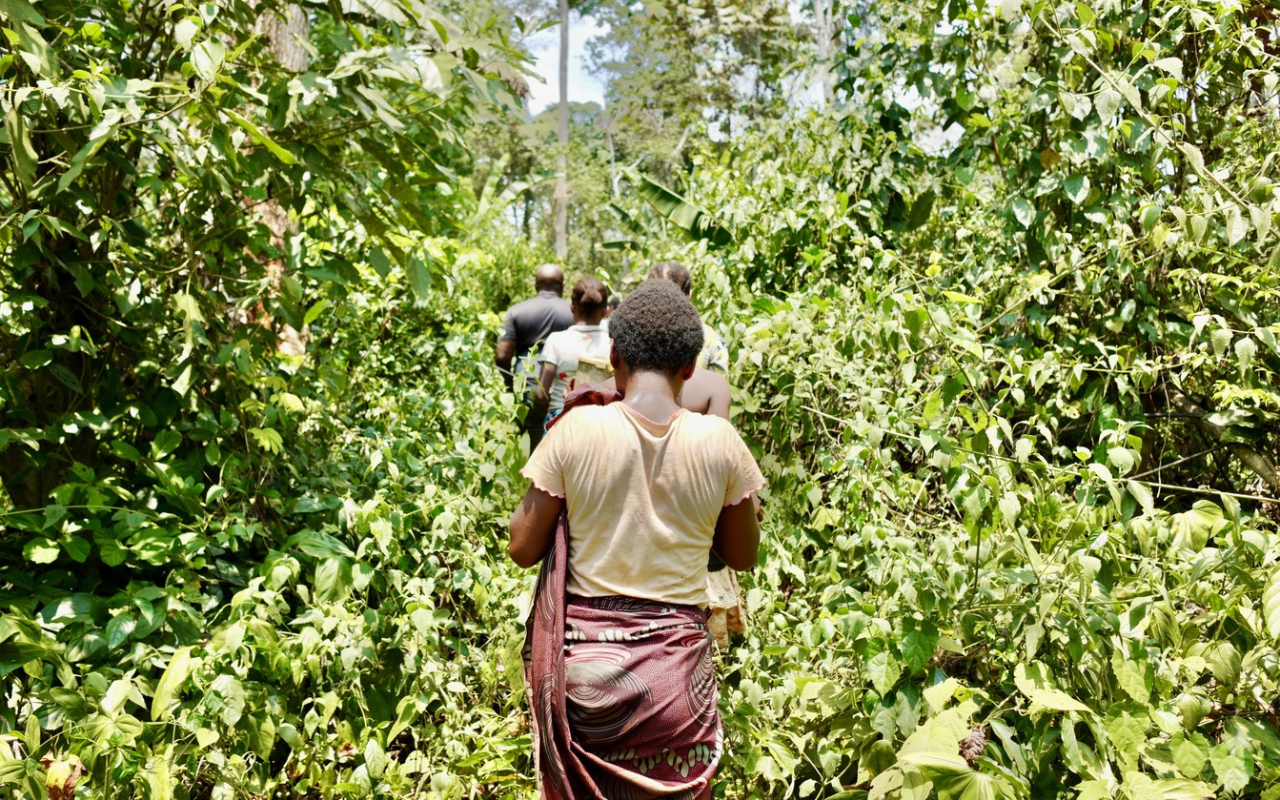
A focus on fragile contexts highlights development policy’s unique contribution to security policy and shows how the special initiative “Transformation of Agricultural and Food Systems“ itself needs to develop further.
The Töpfer Müller Gaßner GmbH (TMG) as a "Think Tank for Sustainability" supports the implementation of sustainable development targets and the Paris Climate Agreement.
Germany’s Ministry for Economic Development and Cooperation (BMZ) has recently launched its new strategy “Shaping the Future Together Globally.“ The strategy prominently situates development policy as an integral part of Germany’s security policy.
This brief analysis spotlights how investments in food systems can contribute to stability in fragile contexts and underlines that BMZ’s strategic goals of ending hunger and creating stability and peace are intertwined.
The goal of ending hunger depends on progress towards achieving food and nutrition security in fragile contexts
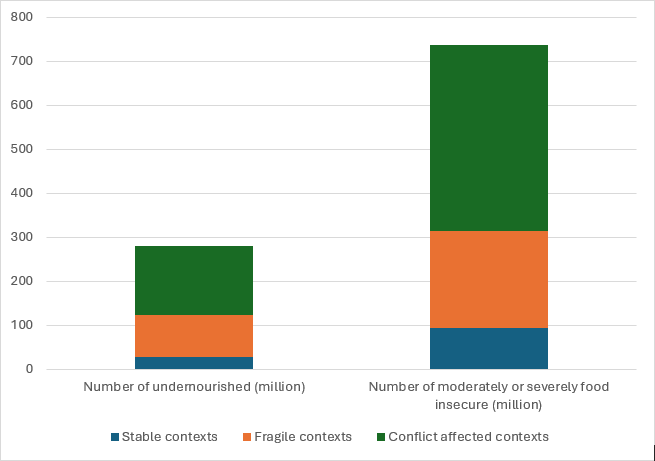
The latest figures by the UN “Food and Agriculture Organization” (FAO) show that 280 million people on the African continent are undernourished, and 740 million people are moderately or severely food insecure. The majority of them, around 55% in both categories, live in contexts that are classified as fragile and affected by conflicts.1 10% live in contexts that are neither fragile nor affected by conflicts. Around a third of undernourished and food-insecure people live in fragile contexts that are not affected by conflicts. In absolute numbers, these are 94 million people who are undernourished, and 220 million are moderately or severely food insecure (see figure 1). If a focus on fragility were equated with a focus on conflict-affected areas, these people would move out of sight.
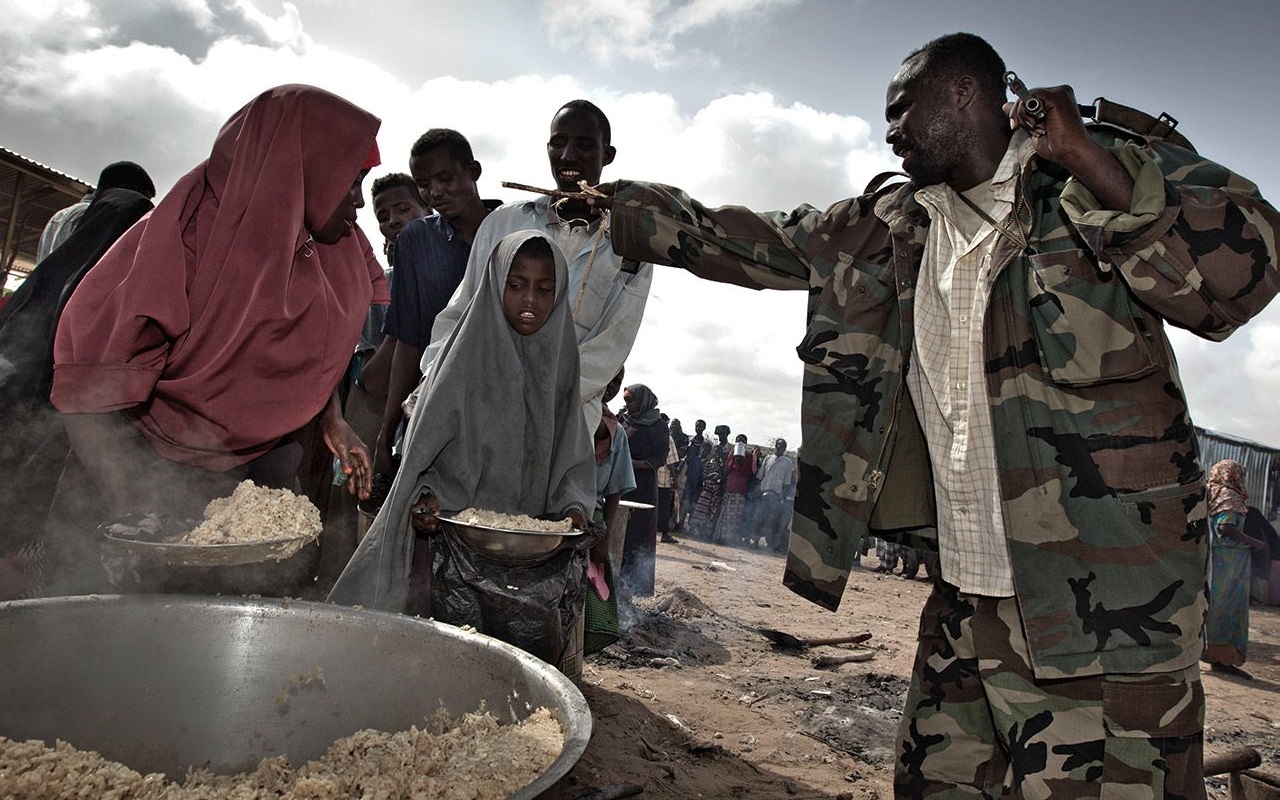
Fighting hunger in conflict-affected contexts mostly demands humanitarian aid. Hostilities between warring parties make long-term development investments risky or impossible. The situation is different in fragile contexts that are not affected by conflicts.
Fragility can be caused by a range of factors as diverse as a government incapable of delivering public services, macroeconomic instability, or an education system that sidelines women and girls. These structural impediments to inclusive development and to fighting hunger and poverty have long been addressed by development policy. BMZ and GIZ possess decades of experience and the necessary partner networks to address the structural factors driving food and nutrition insecurity in fragile contexts.
Investments in fragile contexts matter to achieving stability. The 2025 edition of the “Organization for Economic Cooperation and Development” (OECD)’s “States of Fragility” report emphasises that state and non-state actors exploit fragilities. These actors do not see fragilities as a development challenge to be overcome but as a lever to advance their own political goals.
Prevention means addressing the root causes of conflicts and grievances, one of which is access to land
In 2018, the United Nations and the World Bank published “Pathways for Peace,” a study on lessons learned for preventing violent conflict. Pathways for Peace concludes that “prevention must proactively and directly target patterns of exclusion and institutional weaknesses that increase risk [of conflicts]” (p. xi). This implies addressing the structural factors that cause grievances and contribute to conflict. One such structural factor is inequalities in access to resources, such as land and water.
Consider the north of Benin as a case in point. Prevailing agricultural policies favour cash crops such as cotton. The spread of farms has cut off pastoralists from scarce water sources and their former migration routes. The result is deep grievance among herder communities. Jihadist groups exploit these grievances. Armed Conflict Location and Event Data (ACLED) shows that since 2024, jihadist groups have pushed further into northern Benin.
Government responses to jihadist groups still rely mainly on security-led, militarised action. The UNDP study “Journey to Extremism in Africa” shows that security-focused responses create further grievances. In interviews, former combatants who name a specific trigger for joining extremist groups, 70% point to the killing or arrest of family members or friends by the police or military. Pathways for Peace highlights that such state repression poses a “grave risk of violent conflict” (p. viii).
The recognition of legitimate land rights, including traditional and collective land rights, is a priority investment area to prevent fragile contexts from descending further into conflict.
Achieving food and nutrition security in fragile contexts depends on strengthening informal service delivery systems
One reason for fragility is a government that lacks the capacity to systematically deliver services to its citizens. To close this service delivery gap, development policy has long begun to work closely with communities, civil society, and the private sector. Community health workers serve as a bridge between citizens and the public health systems. Paralegals assume a critical role in improving access to justice. Community-based organisations are key to reaching vulnerable households. Cooperation with these actors is a long-standing feature of Germany’s development policy.
Increasing the outreach of food and nutrition security programmes in fragile contexts depends on a different way of cooperating with these non-governmental, or informal, service providers. TMG’s experience in working in fragile contexts shows that service delivery systems for food and nutrition security are characterised by two concurrent features:
Civil society-driven initiatives that reach the most vulnerable households often operate at a limited scale and are largely project-funded, which threatens their sustainability. Community kitchens in informal settlements serving food to those who are affected by rising food prices are one example of such service delivery systems.
Public services that are equally limited in their outreach and, in the case of agricultural production, tailored to the needs of those who can pay for them. Examples include extension services targeting producers of cash crops and demand-driven extension services.
In effect, food-insecure households are not systematically reached by either service delivery system. To change this situation in times of strained public budgets requires a new way of cooperation between the two.
In TMG’s experience, there is limited public discourse about and investment in creating interfaces between the two systems. How do civil society-driven systems need to change so that they can become service delivery partners of public systems and development partners? How do public systems create the interfaces to support informal systems? How to avoid formalising solutions in a way that leads to crowding out those who currently deliver the services to the most vulnerable?
To give an example. Public school meal programmes in Nairobi serve only public schools. Many of the food-insecure children, however, attend complementary, private-run schools in informal settlements. In Mukuru, one of Nairobi’s largest informal settlements, 28,000 pupils attend complementary schools (75% of all pupils in Mukuru). These schools are not attended by public programmes. Community-run initiatives set up informal systems to compensate for the lack of public services. Their response, however, is not at the scale required to reach all pupils. VICCO is a community-based organisation offering school meals to pupils attending complementary schools in Mukuru. TMG’s work with VICCO shows that it is possible to achieve cost recovery rates above the public system's requirements, even in the challenging context of an informal settlement. Yet, the costs of contracting and supervising VICCO would currently be prohibitively high, making it unlikely that VICCO would become a partner of the county government or development partners.
Ending hunger in fragile contexts requires a new approach to service delivery. Such a service delivery system would work with and strengthen informal solutions. The continuation of BMZ’s special initiative “Transformation of Agricultural and Food Systems“ offers the opportunity to address this need.
The future is likely to hold increasing fragility
Scenarios of future climate show that the world will soon overshoot the 1.5 °C target of average global warming. UNEP’s latest Emission Gap Report projects peak warming of 1.9 - 2.8 °C. The extent and duration of the overshoot will depend on the decisiveness of climate action. During the overshoot, the world will experience more extreme weather events. Extreme weather events will increase fragility, particularly in societies in which agriculture significantly contributes to Gross Domestic Product.
In the near future, food system investments for human security will become ever more important.
1 For conflict-affected countries, please see the World Bank classification. Data on fragile contexts is based on OECD. The numbers provided above include contexts that are characterised as being in a state of high or extreme fragility.
The United Nations plan a Food Systems Summit - and now the Corona-Virus is dictating the agenda. The Chief Economist of the UN World Food Programme takes stock of the current situation: a conversation with Jan Rübel about pandemics, about the chromosomes of development - and about the conflicts that inhibit them.
African countries still face huge gender gaps in terms of access to work and capital. What are the consequences of Corona for women in Africa? Jan Rübel interviewed Léa Rouanet on lockdowns and gender-based violence. The economist works at the Africa Gender Innovation Lab of the World Bank.
Every year in October, the "Welthungerhilfe" aid organisation, with the Irish "Concern Worldwide" NGO, publishes the Global Hunger Index, a tool with which the hunger situation is recorded. What are the trends - and what needs to be done?
Shortly before ending his position as Director General of the International Food Policy Research Institute (IFPR) Dr. Shenggen Fan talks about the reforms and new modes of operation needed to achieve global food security in the coming decade.
Over a period of two years, the Ceres2030 team spent researching answers to the questions of how much it will how much it will cost to realize SDG 2 and where that money should be spent most effectively. IISD Senior Advisor and Ceres2030 Co-director Carin Smaller about small farmers, machine learning and women empowerment.
The CGIAR agricultural research organization is systematically repositioning itself. We spoke with Juergen Voegele, Vice President for Sustainable Development at the World Bank, about progress to date - and discuss what needs to be done collectively to stop global hunger in ten years.
The first Climate Adaptation Summit put climate adaptation at the center of politics for the first time. The virtual meeting united global players with one goal: building resilience is just as important as climate protection itself. Around 15,000 participants discussed direct proposals.
110 speakers from 120 countries met virtually at the Global Forum for Food and Agriculture (GFFA) to discuss the challenges to global food supply. They asked the question: How can food systems support the health of people and the planet?
Yemen is currently experiencing one of the worst disasters, due to war, hunger and disease outbreaks. The GIZ is locally engaged to improve the nutrition and resilience of Yemenites.
International agricultural research is responding to new challenges: Their advisory group is undergoing a fundamental reform process and unites knowledge, partnerships and physical assets into OneCGIAR.
From the lab to the masses: Maria Andrade bred varieties of biofortified sweet potatoes which are now widely used all over the continent. She sets her hope on the transformation of African agriculture.
A contribution by Heike Baumüller, Christine Husmann, Julia Machovsky-Smid, Oliver Kirui, Justice Tambo
Any initiative whose aim is to reduce poverty in Africa should focus first on agriculture. But what kind of investment has the greatest impact? The use of scientific criteria provides some answers.
The lockdown due to COVID-19 hit the economy hard - including agriculture in particular with its supply chains and sales markets. What creative coping strategies have those affected found? The Seminar for Rural Development has begun a research study on th
African inland fisheries are increasingly reliant on the capture of small fish species that are sundried and traded over long distances. They make an important contribution in alleviating “hidden hunger”: consumed whole, small fish are an important source of micronutrients. Only that, unfortunately, politicians haven’t yet realised this.
A contribution by Jes Weigelt and Alexander Müller
What is required to make food systems provide sufficient, healthy food while not harming the planet? How should food security be maintained given the threat posed by climate change? Our authors look at some aspects of tomorrow’s food systems against the backdrop of the corona crisis.
Freshwater deficits are affecting more and more people throughout the world. In order to counter this, our global food system will have to change, our author maintains. A case for more research on alternative crops and smart water solutions.
Lack of seasonal workers and virus explosion in slaughterhouses, rising vegetable prices, climate crisis – all this demonstrates: Our food system is highly productive and (at least for the rich inhabitants of planet earth) guarantees an unprecedented rich and steady food supply - but it is not resilient.
A contribution by Sarah D´haen & Alexander Müller, Louisa Nelle, Bruno St. Jaques, Sarah Kirangu-Wissler and Matteo Lattanzi (TMG)
Young farmers’ insights on the effects of the COVID-19 pandemic on food systems in Sub-Saharan Africa @CovidFoodFuture and video diaries from Nairobi’s informal settlements.
A contribution by Kerstin Weber and Brit Reichelt-Zolho (WWF)
Biodiversity and sustainable agriculture ensure the nutrition of whole societies. But there is more: These two factors also provide better protection against the outbreak of dangerous pandemics. Hence, the question of preserving ecosystems is becoming a global survival issue.
There is a clear global task: We need to feed nine billion people by 2050. We, the people of Earth, must produce more food and waste less. That is the top priority of the UN World Food Programme (WFP), too - the description of a challenge.
At the beginning of December 2018, AGRA's board of directors met in Berlin. The "Alliance for a Green Revolution in Africa" panel discussed the next steps in their policy of modernizing agriculture. How to go on in the next ten years? One question - many answers from experts.
Double interview with Tony Rinaudo and Volker Schlöndorff
Tony Rinaudo uses conventional reforestation methods to plant millions and millions of trees – and Volker Schlöndorff is filming a cinema documentary about the Australian. The outcome so far: An educational film on behalf of the BMZ (Federal Ministry for Economic Co-operation and Development).
A study by Markus Hanisch, Agustina Malvido, Johanna Hansmann, Alexander Mewes, Moritz Reigl, Nicole Paganini (SLE)
Post-Covid-19 lockdown: How food governance processes could include marginalised communities - an extract of the results of an SLE study applying digital and participatory methods.
Joe DeVries is a breeder – and Vice President of AGRA (Alliance for a Green Revolution in Africa). What are the chances and risks of a ’green revolution‘ in Africa? A discourse between Jan Rübel and him about productivity, needs, and paternalism.
If there is a lack of fertile soil and rain, hunger breaks out quickly. Maria Smentek from the World Food Programme (WFP) explains how farmers and pastoralists can counter climate change with hydroponic-systems.
Insect farming is economical and environmentally sustainable, they are high in protein and they live on agricultural waste. Marwa Abdel Hamid Shumo thinks: They are the best weapon to combat hunger
Urban gardening is becoming increasingly popular in northern metropoles. People who consider themselves part of a green movement are establishing productive gardens in the city, for example on rooftops or in vacant lots. In severely impoverished regions of the global South, urban agriculture is a component of the food strategy.
Supporting groups of smallholding women substantially contributes to strengthen rural operations economically. The organisation and associated group activities can help to reduce extreme poverty and improve the food situation.
Chancellor Merkel has begun an ambitious European political programme: Striving for compromise in budget negotiations, an orderly Brexit as well as an appropriate response to the corona crisis. Unfortunately, one of her positions that she previously held is nowhere to be found: Africa's prosperity is in the interest of Europe.
The majority of producers in developing countries are women. Although they contribute significantly to the food security of their families, they remain chronically disadvantaged in male-dominated agriculture in terms of access to land, credit, technology and education.
A contribution by Nadine Babatounde and Anne Floquet (MISEREOR)
To prevent malnutrition among young children and strengthen the role of women in their communities, Misereor, together with the local non-governmental organisation CEBEDES, is implementing a programme on integrated home gardens in Benin - a series of pictures.
The Global Agriculture and Food Security Program (GAFSP) was launched by the G20 countries in 2010 in response to the 2008-09 food price crisis to increase both public and private investment in agriculture. An overview of the programme's approach, results and impact.
Even though COVID-19 poses a threat to the health of humanity, the reaction to the pandemic must not cause more suffering than the disease itself. This is particularly relevant for poor developing countries, where the impact of the corona crisis on food security is even more severe!
In most African countries, the infection COVID-19 is likely to trigger a combined health and food crisis. This means: In order to cope with this unprecedented crisis, consistently aligning our policies to the Sustainable Development Goals (SDGs) is more important than ever, our author maintains.
COVID-19 has unprecedented effects on the world. As always, the most vulnerable are the hardest hit, both at home and - especially - abroad. A joint appeal by the German Federal Ministry for Economic Development and Cooperation (BMZ) and the Department for International Development (DFID).
The region of Sub-Saharan Africa is on the decisive verge of a great development boost in farming: it could skip entire generations of technological development. But how? About possible roles and potentials of digital services.
A contritbution by Essa Chanie Mussa (University of Gondar)
Rural youth need viable livelihood opportunities to escape out of poverty and realize their aspirations. How could they be helped to fully unleash their potential? This is an aloud call that needs novel strategies among governments, policy makers, and international development partners and donors.
Enabling smallholders to trade across regions and borders promotes food security and economic growth. Although everyone is calling for exactly that, implementation is still difficult
A report by Bettina Rudloff and Annette Weber (SWP)
The Corona-Virus exacerbates existing crises through conflict, climate, hunger and locusts in East Africa and the Horn of Africa. What needs to be done in these regions? To face these challenges for many countries, all of these crises need to be captured in their regional context.
A report by Alexander Müller and Jes Weigelt (TMG)
As the climate changes, the population of Africa is growing and fertile land and jobs are becoming scarcer. New ways are currently leading to urbanisation of agriculture and a new mid-sized sector in the countryside
A contribution by Michael Brüntrup (DIE) und Daniel Tsegai (UNCCD)
Droughts are the natural disasters with far-reaching negative consequences. While rich countries are still vulnerable to drought, famines are no longer found.
Climate change is destroying development progress in many places. The clever interaction of digitalisation and the insurance industry protects affected small farmers.
A study by the World Bank predicts that millions of people in sub-Saharan Africa will have to leave their homelands because of climate change. We have spoken with one of the authors
Nutrition experts from all over the world are coming together in Rome. They are not only distilling 2000 ideas to improve food systems - they are also preparing for the big UN summit in New York in September. An interview.
Journalist Jan Rübel spoke with Joao Campari ahead of the UNFSS Pre-Summit. The Chair of Action Track 3 highlights key challenges in transforming existing food systems towards sustainable production and shares his expectations for the Summit.
A contribution by Dr. Karin Gaesing and Prof. Dr. Frank Bliss (INEF)
Especially in densely populated areas, land pressure leads to overexploitation of available land and a lack of conservation measures. The West African country of Benin, with heavily depleted soils in many places, is no exception.
Interview with Paul Newnham, Director of the SDG 2 Advocacy Hub.
The UN Food Systems pre-Summit in Rome dealt with transforming the ways of our nutrition. How do you bring that to a broad public? Questions to Paul Newnham, the Director of the Sustainable Development Goal (SDG) 2 Advocacy Hub.
An Interview with Francisco Marí (Brot für die Welt)
Brot für die Welt (Bread for the World) did not attend the UNFSS pre-summit. Instead, the organisation took part in a counter-summit that took place at the same time. A conversation with Francisco Marí about the reasons, the process - and an outlook for the future
Interview with Martina Fleckenstein (WWF), Michael Kühn (WHH) and Christel Weller-Molongua (GIZ)
After the summit means pre-summit: It was the first time that the United Nations held a summit on food systems. Martina Fleckenstein, Michael Kühn and Christel Weller-Molongua reviewed the situation in this joint interview.
Vitamin-poor nutrition must become more expensive, in-vitro meat is not a panacea, and agricultural systems should be more decentralised. Bioland President Jan Plagge in an interview about the challenge of (future) world nutrition.
Genetically modified bacteria become edible proteins, cows graze on pasture, and no waste is produced in an industrial circular economy. Journalist Jan Grossarth sees a silver lining for the future of world nutrition
A Contribution by Emile Frison and Nick Jacobs (IPES-Food)
While having failed to solve the hunger problem, industrial agriculture appears to be causing additional ones both in environmental and health terms. Emile Frison and Nick Jacobs call for a transformation.
Fish is important for combating malnutrition and undernourishment. But it is not only notable for its nutritional value, but also secures the livelihoods and employment for 600 million people worldwide.
Three quarters of the world's population do not have secure land rights, which hinders investment and innovation. The project "Improvement of Livelihood and Food Security" supports smallholder farmers in acquiring land.
Vertically growing plants, magnetic cotton. Hairy leftovers fertilizing fields, tractors running on algae? These six innovations could lead agriculture’s next Green Revolution!
Climate change already affects the daily lives of people in the Global South. What are the challenges they face and what do these imply for negotiations at the climate conference in Glasgow?
A Contribution by the Forestry Research Institute Nigeria
The 'Domestication of Small Monogastric and Ruminant Animals' (DSMR) project led by a Nigerian research institute works with local communities to solve the bushmeat crisis.
In the run-up to the G7 summit, experts from politics and civil society discussed sustainable and more effective options for action by the G7 states to combat hunger.
The G7 is responding to the worsening global hunger crisis by mobilizing an additional $4.5 billion for this year alone. A key milestone for this in the run-up was the international conference on global food security "Uniting for Global Food Security".
Healthy, productive soils are a prerequisite for global food security – one of the priorities of German development cooperation. State Secretary Jochen Flasbarth on Germany’s efforts to support sustainable land management and why the VGGT are more important than ever today.
How can we reach more people with successful approaches to food security? In Berlin, an international conference organized by the Deutsche Gesellschaft für Internationaler Zusammenarbeit (GIZ) addressed this issue.
Whether it's banana bread made from brown bananas, conscious shopping plans or foodsharing, we give you five tips on how to reduce your everyday food waste.
Why are short- and long-term responses important to address current and future global crises? Sebastian Lesch, Head of the Agriculture Division at the German Federal Ministry for Economic Cooperation and Development (BMZ), provides answers to these and other questions in an interview with the Global Donor Platform for Rural Development (GDPRD) and explains how much Germany welcomes all donors pulling together and acting in concert.
How to maintain functioning food markets in global food supply chains in the face of vulnerability and disruption? Markets that support local and territorial food systems are part of the solution. Thomas Forster presents proposals for these markets to cope with future shocks.
The Global Alliance for Food Security (GAFS), jointly launched by the German G7 Presidency and the World Bank, released the Global Food and Nutrition Security Dashboard during COP27: A Rapid Response Tool for Coordinating Global Action for Food Security.
How can the challenges related to water, rural development and climate resilient agriculture be addressed? What innovations need to be promoted? The Water and Energy for Food (WE4F) initiative presents strategies and innovations for sustainable, integrated water management in German and international cooperation.
A Year of Multiple Crises: Russian war against Ukraine, extreme weather events, high prices for energy and fertilizer, food crisis had severe implications for food security and agriculture globally and especially in Sub-Saharan Africa. A Transformation of the food systems is needed.
Since early February 2022, two of the biggest grain and oilseed exporters have been at war. An overview, which countries are affected most severely by the destabilized grain markets, and what comes next.
Development cooperation needs to place good governance and a sustainable agri-food systems transformation at its center: After the first 100 days in office have passed, Dirk Meyer from the German Development Ministry (BMZ) spells out the goals, guidelines and priorities of the Ministry’s new lead.
Rising food and gas prices, physical destruction and supply chain disruptions: Why the Black Sea region matters and how the war in Ukraine affects global food security.
A Contribution of the 'Initiative for Sustainable Agricultural Supply Chains' (INA)
Fair Trade organisations and the Initiative for Sustainable Agricultural Supply Chains (INA) have launched the #ichwillfair campaign during COP26 to highlight the link between global supply chains and climate change.
New insights on trade and value addition in the rice sector in West Africa
Low import tariffs, smuggling activities, unpredictable tax exemptions and weak enforcement of food safety standards: The potential of local rice value chains is undermined in West African countries.
The Corona pandemic is hitting economies around the world very hard - but developments in African countries are quite diverse. There are different speeds, resiliences and vulnerabilities. What are the reasons for this? Apl. Prof. Jann Lay of the GIGA Institute provides answers.
A contribution by Prof. Dr. Anna-Katharina Hornidge
In the video format "#99SecondsWith" of the German Institute of Development and Sustainability (IDOS), Prof. Dr Anna - Katharina Hornidge talks about the new Africa-Strategy of the Federal Ministry for Economic Cooperation and Development (BMZ).
Four interviews kick off the relaunch under the new name „Food4Transformation“, asking the same questions from different perspectives. Mareike Haase and Stig Tanzmann from Brot für die Welt explain why the right to food, inclusivity, agroecology and food sovereignty are the central levers for a successful transformation.
Four interviews kick off the relaunch under the new name „Food4Transformation“, asking the same questions from different perspectives. Dr Julia Köhn, Chair of the German AgriFood Society, points out in the interview: Only if innovation and transformation are profitable in the medium term can they close the food gap in the long term.
The Federal Ministry for Economic Cooperation and Development (BMZ) has released a video on the transformation of agricultural and food systems. In the video, Federal Minister Svenja Schulze also speaks about the urgent need to combat global hunger and contribute to resilient agricultural and food systems.
Four interviews kick off the relaunch under the new name „Food4Transformation“, asking the same questions from different perspectives. Dirk Meyer, Federal Ministry for Economic Cooperation and Development, thinks: less individual solutions are needed, but more systemic approaches. Because in addition to the goals for food security, the issues of climate and biodiversity must also be taken into account.
A Contribution by Dr. Fatima Olanike Kareem and Dr. Olayinka Idowu Kareem
High agricultural prices affect developed and developing countries alike, but the problem is aggravated for the latter through the lack of or inadequate resilience measures. Dr. Fatima Olanike Kareem, AKADEMIYA2063, and Dr. Olayinka Idowu Kareem, University of Hohenheim, explain what can be done to mitigate the negative effects on food security.
The consequences of the Russian invasion of Ukraine have enabled many countries to open up new export markets for their agricultural goods. However, smallholder farms have been largely left out. Drawing on his experience in India, our author gives a brief overview of how this can be changed.
A contribution by the Global Donor Platform for Rural Development
Two years following the UN Food Systems Summit, the Global Donor Platform for Rural Development and the Shamba Centre for Food & Climate hosted an official side event at the UNFSS+2. The event explored how public donors can increase the impact of their investments.
Iraq suffered many years of war, sanctions and economic crises. However, Ally-Raza Qureshi from the World Food Programme in Iraq sees progress. But now the effects of climate change are becoming apparent in the country. What is to be done?
The world is currently experiencing a historic food crisis. High fertiliser prices are part of the problem. In addition to the necessary short-term aid measures, the crisis ought to be made use of to develop and implement longer-term fertiliser strategies for sustainable, in particular smallholder increases in production in the Global South.
In a world facing crises – from pandemics, armed conflicts, and climate change – how do we ensure everyone has enough food within planetary boundaries? A new podcast by Food4Transformation discover solutions talking to government officials, scientists, NGOs and farmers around the world.
The Gaza Strip depends heavily on humanitarian aid, more than ever with the current war. Gaza population is very young: Half of them are children. What is their situation on the ground? Questions for Lucia Elmi, Unicef Special Representative to the State of Palestine.
In Sub-Saharan Africa, not all financial institutions (FIs) have access to knowledge about how to implement processes to enhance rural financial inclusion. The pan-African Community of Practice (CoP) plays a pivotal role in supporting these institutions along this transformative journey.
How can agriculture engage more young people in rural areas? Advocacy and education campaigns can play an important role here. Simeon Kambalame, Timveni Child and Youth Media Organisation, has launched such a campaign in Malawi.
Women and girls in poorer countries are affected in particular ways by the multiple crises the world is currently facing. Uncovering the linkages between gender, resilience and food security, experts from International Food Policy Research Institute (IFPRI) look at ways to support women and girls’ capacity to respond to crises.
The armed conflict between Israeli forces and the Hamas is escalating. What does this mean for a Gaza, region that was already heavily dependent on external aid? Questions for Dr. Muriel Asseburg, Senior Fellow at the German Institute for International and Security Affairs (SWP) in Berlin.
Chancellor Angela Merkel in the Podcast of the Federal Government
At the start of World Food Week around World Food Day on 16 October, Chancellor Angela Merkel stressed that the fight against global hunger will only be successful with international responsibility and solidarity (german only).
From measures to promote biodiversity in Germany to more sustainable cocoa cultivation methods in Ecuador: WWF works at many different levels. At the Green Week, it will be demonstrated just how multifaceted nature conservation work is and what role each individual's decision plays.
The Agriculture and Food Security Cluster of the Deutsche Gesellschaft für Internationale Zusammenarbeit (GIZ) GmbH in Zambia shows how synergies among different projects and partner organisations can help people to eat healthier, diversified food. A delegation of the Bonn based Division of Agriculture and Rural Development learned this in a field visit in the Eastern Province of the Southern African country.
Felix Phiri has been Head of the Department of Nutrition, HIV and AIDS at the Ministry of Health in Malawi for almost 20 years. A conversation about constants and change.
Every second, worldwide, we lose valuable and healthy soil with the size of four football fields. This was only one of the many facts being presented to a wide audience in Bonn and worldwide via livestream at the World Desertification and Drought Day on 17th June 2024. This was the 30th anniversary of the United Nations Convention on Combatting Desertification (UNCCD), which was celebrated at the Bundeskunsthalle in Bonn.
In Himachal Pradesh, India, natural disasters are becoming more frequent and climatic conditions are changing – with negative consequences for apple production and farmers' livelihoods. Holistic and multidimensional innovation bundles are required for the entire value chain in order to make the food system more resilient in the future.
Africa’s largest youth generation has the potential to transform agriculture sustainably. Young entrepreneurs like Febelsa in Mozambique are building agricultural businesses that fuel local growth.
The guiding orientation framework developed by the Deutsche Gesellschaft für Internationale Zusammenarbeit (GIZ) summarizes the requirements for the transformation of agriculture and food systems – and identifies principles and approaches for transformative change.
A Contribution by Emmanuel Atamba & Larissa Stiem-Bhatia
Drawing on dialogues with experts in Kenya, TMG Research releases its latest policy brief highlighting the critical need to strengthen coordination mechanisms in food systems governance. Emmanuel Atamba and Larissa Stiem-Bhatia from TMG Research summarize the results.
Diversifying our protein supply to include plant-based foods and cultivated meat can be a game-changer for climate mitigation and climate adaptation, especially in the countries of the Global South. However, a great deal of research is still required to capitalise on this potential. And political support, as Ivo Rzegotta, Good Food Institute, demonstrates.
From January 9 to 11, 2025, heads of state and government of the African Union met in Kampala, Uganda. With a clear vision and concrete measures, the Kampala Agenda aims to make the continent's agricultural and food systems climate-resilient, fair and future-proof by 2035.
The Federal Ministry ofor Economic Cooperation and Development (BMZ) and the Federal Ministry of Food and Agriculture (BMEL) presented a revised version of the 10-Point Plan for a sustainable cocoa sector. The plan takes into account new supply chain legislations and current developments. A particular focus is paid to a living incomes, responsible purchasing practices and ecological and climate-friendly cocoa cultivation.
At the Nutrition for Growth 2025 Summit in Paris, Team Europe, comprising the European Commission and Member States, put nutrition at the centre of international politics as a driver for resilience, equality and human rights. There is a consensus on the results of the summit: to turn commitments into concrete progress through strong partnerships and innovative approaches.
The global fight against malnutrition needs more than just words - as demonstrated by the Nutrition for Growth summit in Paris. With comprehensive commitments and clear receivables, a signal has been sent: Healthy nutrition must become a global priority. But what do participants from countries such as Yemen and Timor Leste think?
With a simple but effective idea to combat malnutrition: in Nairobi, Fabio Rappenecker and his start-up TenX Nutrition produce mandazi, which become a real power biscuit thanks to added micronutrients. The aim is to strengthen food security through local, affordable and healthy food.
Amid rising global hunger, urbanization, and shrinking international funding, informal food systems are crucial for food access and livelihoods in low-income African urban areas. The TMG Think Tank’s paper, “Working with Informality for Food Systems Transformation and Resilient Communities,” highlights the importance of recognizing and working with informality to achieve Sustainable Development Goal 2.
Two new podcast formats from the Deutsche Gesellschaft für Internationale Zusammenarbeit (GIZ) bring stories from on-the-ground project work to life: "Over to you!" from Malawi and "Voices of Change – Beneficiary Story Book" from Zambia. At the heart of these podcasts are the people behind the changes toward sustainable food security.
Food systems vary widely between communities. While global agendas offer general guidance, effective change requires context-specific interventions at the local level. Placing the needs of local communities at the center of these efforts is essential. The visioning process can help achieve this, says Fyness Lydia Ching’oma from GIZ Malawi.
A Contribution by the German Institute for International and Security Affairs (SWP)
Against the backdrop of the current conflict in Iran and the associated closure of the Strait of Hormuz, the strategic significance of maritime infrastructure has acquired renewed urgency. A 2024 study by the Stiftung Wissenschaft und Politik (SWP) examines this relevance and discusses appropriate protective measures for different forms of critical infrastructure within the maritime space.
AnInterview with Rashid Sumaila and Andreas Schaumayer
Against the backdrop of the eleventh Our Ocean Conference in Mombasa, Kenia, leading fisheries economist Rashid Sumaila and Andreas Schaumayer, German Federal Ministry for Economic Cooperation and Development (BMZ), reflect on the state of global fisheries in 2026: from the hidden economic power of small-scale fishing communities to the data gaps that leave millions of fishers uncounted.
Risk Reduction is his job. As Head of Disaster Risk Management at the Intergovernmental Authority on Development (IGAD), Dr. Ahmed Amdihun works at the intersection of climate resilience, early warning systems and humanitarian preparedness across the Greater Horn of Africa. In this interview, he explains what is needed to strengthen resilience in one of the world's most fragile regions.
An Interview with Shamika Mone (INOFO) and Elizabeth Nsimadala (EAFF)
At the UN Food Systems Summit, farmers organizations have been represented on the international stage for the first time ever. Two representatives talk about bridging personal aspirations with the representation of regional needs and international negotiations.
The potential the African food sector holds is still far too strongly associated with the continent’s natural resources, Ben Leyka maintains. He seeks to change this with the African Agri Council.
After a two-year break due to Corona, the doors of the International Green Week (IGW) in Berlin are opening again. From 20th to 29th January, visitors from all over the world can discover, marvel and taste the produce. But the event is not only feasting and fun. The BMZ stand asks questions about where food comes from & where it goes – and in the process becomes a crash test for many habits.
The transformation of food systems is regarded as the new magic code, but effective strategies are lacking. A new group of experts discussed the prerequisites for efficiently managing this process. The experts representing politics, youth, civil society, farmers' organizations, private sector, and academia unanimously concluded: transformation is possible, but it needs a strong drive from within.
Russia's war against Ukraine and its impact on food, energy and fertiliser prices is worrying farmers all over the world. Young farmers, farmer organisations and politicians from Kenya, Chad and Ukraine tell their stories and what keeps them in agriculture.
During the trade Grüne Woche, school classes visited the BMZ (German Federal Ministry for Economic Cooperation and Development), Brot für die Welt and Misereor. Each class spends one hour at their stand to learn about the global challenges posed by food systems. A review by Jan Rübel.
An Artikel by the Initiative for Sustainable Agricultural Supply Chains (INA)
A study published by the Deutsche Gesellschaft für Internationale Zusammenarbeit (GIZ) examines the differences between globally traded agricultural commodities and domestic niche products in terms of economic, environmental and social impact on the region of origin. The results provide new evidence to make supply chains more sustainable.
The Import Promotion Desk (IPD) accompanied organic producers from developing and emerging countries to Biofach. In an interview, Dr Julia Bellinghausen, head of the IPD, explains the importance of organic certification in export promotion.
Taking a look at the data (as of February 11th 2022) what the current price hike means for world hunger and what can be done to prevent from another food crisis.
Until Easter 2022, GIZ publishes a new episode every fortnight introducing people who are committed to fair and sustainable cocoa in Côte d'Ivoire and Germany.
Stephanie Heiland, Project Manager at Sector Project Agriculture and part of this year’s Observer Delegation of the Deutsche Gesellschaft für Internationale Zusammenarbeit (GIZ) at COP27, shares her insights on the role of agriculture and food systems at the climate conference. Among other things, she reports from GIZ’s COP27 side event ‘Climate resilient agriculture and food systems in times of multiple crises and fragility’.
Experts from Burkina Faso, Cambodia, Ethiopia, India, Kenya and Malawi came together to discuss inclusive governance in a workshop entitled "Inclusive Governance of Food Systems Transformation". Daniel Montas, TMG Research, on the findings.
A Contribution by the Federal Ministry for Economic Cooperation and Development
At the network meeting "Partners for change - Transformation to a food secure, resilient and sustainable future", almost 250 participants from over 20 countries came together to exchange experiences and ideas on the transformation of agricultural and food systems. The final product, joint recommendations to transform agricultural and food systems, can now be read online.
Halfway through the 2030 Agenda, the BMZ invited participants to a network meeting entitled "Partners for change - Transformation to a food secure, resilient and sustainable future". Experts from around the world developed recommendations in a consultation process and then consolidated them in Berlin. A site visit.
The complex interrelationships of the sustainable transformation of agricultural and food systems are not always easy to understand - the Agri-Food Map, an interactive online app, makes the comprehensive relations accessible by providing a wide range of comprehensibly prepared information.
A Contribution by Harry Hoffmann (TMG) & Nathalie Demel (WHH)
At the halfway mark of the 2030 Agenda and two years after the UN Food System Summit 2021, a stocktaking moment was held in Rome to analyze the progress of countries on the commitments to action in transforming food systems. Dr Harry Hoffmann, TMG Think Tank, and Nathalie Demel, Welthungerhilfe, were on site and take stock as well.
The production of animal-source foods is becoming increasingly difficult due to the impact of climate change on the livestock sector in Africa. Though, Livestock make a crucial contribution to food security in Africa. Three papers by the Federal Ministry for Economic Cooperation and Development (BMZ), GIZ, ILRI and World Bank analyze, how Africas future livestock sector can look like.
How can rural economies become viable and modern? William Madudike, youth representative of the Zimbabwe Farmers Union (ZFU) and a potato farmer himself, examines this question. He argues that the whole rural economy and actors from producers to consumers need to be considered. An interview on the initiative role of youth.
In the midst of global climate discussions, a resounding call emerges: Women's land rights must be the cornerstone of our climate actions. They're not just pieces of the puzzle; they form the foundation for true climate resilience. TMG Think Tank for Sustainability reports from the first African Climate Summit.
Partnerships are needed to face the multiple shocks for food systems. This is what Dr. Jacqueline Mkindi, president of the Agriculture Council Tanzania (ACT) and CEO of the Tanzanian Horticulture Association (TAHA) states.
It takes the joint efforts of diverse actors to achieve a transformative impact on the global food system. Barbara Rehbinder, Scaling Up Nutrition Movement (SUN), discusses four people-centred principles to get closer to this goal.
Shu Wen Ng is a health economist. She knows what is best suited to go on a plate. But how can this be achieved on a mass scale in countries with lower incomes? "The solutions to gett there already exist," she says, "but what is often missing is courageous leadership to implement them."
Global food systems are confronted with multiple stresses. It is more urgent than ever to make them more resilient, healthier and more sustainable. A key tool in such a transformation is reforming agricultural policies and repurposing agricultural support, as discussed in an online seminar co-organised by the International Food Policy Research Institute (IFPRI).
This year's network meeting of the Partners for Change (P4C), a network of the German Federal Ministry for Economic Cooperation and Development (BMZ), took place in Nairobi, Kenya, on 26 and 27 June 2024. Kah Walla, moderator of the event and CEO of Strategies!, gives an insight into the key findings and learnings.
The bioeconomy movement is fundamentally changing agriculture and food production: through innovative ideas, environmentally friendly approaches and the realization that we need to work together globally to ensure that change truly benefits everyone. At this years’ German Forum for Food and Agriculture (GFFA), the German Federal Ministry for Economic Cooperation and Development (BMZ) focused on this topic.
In 2025, GIZ and the Import Promotion Desk (IPD) celebrate ten years of successful cooperation. With their joint stand at BIOFACH trade fair in Nuremberg, they were able to introduce over 300 organic companies of partner countries to the European market. And the journey continues – despite challenges on the global market.
In March, delegations from nine partner countries met in Berlin at the Partner Conference Scaling Access to Finance for Agripreneurs. Alongside AUDA-NEPAD, IFAD, BMZ, GIZ, and others, around 100 participants worked on practical solutions to support financial inclusion in agricultural transformation and hand over their conclusions to the AU's Kampala CAADP process.
The international soil conference ‘Partners for Change - SOILutions for a Food Secure, Resilient, and Sustainable Future’ brought together almost 150 different stakeholders in Berlin from 20 to 22 May. Its aim: to take stock of existing conservation programmes and pave the way for the future.
A Conversation with Shakuntala Thilsted & Andreas Schaumayer
On the sidelines of the UN Ocean Conference (UNOC 2025), Andreas Schaumayer, Head of Division at the German Federal Ministry for Economic Cooperation and Development (BMZ), and Shakuntala Thilsted, Senior Nutrition Expert at CGIAR, discussed the crucial role of aquatic foods in nutrition, livelihoods, and climate resilience.
In May, this year's "Partners for Change – SOILutions for a Food Secure, Resilient, and Sustainable Future" conference took place. Kah Walla, Moderator of the Conference and Director of Strategies!, summarises the discussions and declares that healthy soils are not just the foundation of agriculture, but the cornerstone of a resilient, equitable, and climate-smart future.
As part of the “Let Me Tell You” series, children across Zambia are discovering fun stories that teach the importance of good food and healthy habits such as fish. Let’s dive into one of these tales together…
A Contribution by Global Donor Platform for Rural Development
The Global Donor Platform for Rural Development has recently published a new White Paper titled “Financing Agrifood Systems for People, Planet and Prosperity.” It outlines a practical agenda to unlock the capital, partnerships, and innovation required to drive change at scale.
Climate adaptation, youth empowerment, and food systems intersect with challenging social and political conditions. Lucky Andrianirina illustrates how young people in Madagascar navigate structural barriers, translate global agendas into local action, and understand agriculture as a space of agency and hope.
At this year’s Partners for Change (P4C) Network Meeting in Berlin in June, participants from more than 40 countries came together to consolidate the outcomes of 18 months of collaboration across the network and develop a shared advocacy agenda for the transformation of agri-food systems. Discussions focused on messages around inclusion, governance, financing, evidence, and country-led implementation – and on how these can translate into concrete policy impact.
A contribution by Dr. May Hokan and Dr. Arnulf Köhncke (WWF)
Due to the coronavirus crisis, the connection between human and animal health has gained new attention. Politicians and scientists are joining forces to propagate the solution: One Health. But what is behind the concept? And can it also guarantee food security for all people worldwide?
The Federal Government is fine-tuning a law that would require companies to ensure human rights – a supply chain law. What are the consequences for the agricultural sector? Dr Bettina Rudloff from the German Institute for International and Security Affairs (SWP) discusses linking policy fields with added value.
The soybean is a natural crop that can be used to make a lot of food. So, Tata Bi started a small processing business first on her own, then with a few other women, which provides the women with an additional source of income year-round besides selling the soybeans.
Besides the well known impacts of Covid19 lockdowns for the adult population, the associated school closures led to 90 percent of the world’s children with no access to schools. However, school meals are in often the only daily meal for children. Without access to this safety net, issues like hunger, poverty and malnutrition are exacerbated for hundreds of millions of children.
‘Fair’ and ‘sustainable’ are key words in Germany’s EU Council Presidency. At the same time, Germany pursues ‘modernization’ of the WTO and ‘rapid progress’ on free trade agreements. Are these goals really compatible? Can we be concerned about fairness and sustainability while continuing with ‘business as usual’?
A conversation with aquatic researcher Shakuntala Thilsted on the long-neglected nutrition benefits of aquatic diets and the empowering qualities of a sustainable aqua-food systems transformation.
A Contribution by Adrian Muller, Catherine Pfeifer and Jürn Sanders (FiBL)
Taking Biodiversity Focus Areas under production or abandoning lower yielding, more extensive production systems is the wrong approach to mastering the looming global food crisis, say the authors of the Research Institute of Organic Agriculture (FiBL).
Protectionist policies like tariffs supposedly protect domestic producers if they cannot compete with cheaper imported products. Some African countries have therefore opted to impose such import restrictions for a number of products. For the case of chicken imports in Ghana, this study analyses whether restrictions would lead to overall positive or negative welfare effects among households.
Nutrition rarely fails for lack of knowledge, but for lack of structure. In conversation with Dr. Sachin Gupte from PATH, attention turns to the often unseen foundations of food systems – where climate pressures, political frameworks, and economic realities shape what can endure, and what cannot.
Stunting as a sign of chronic undernutrition, alongside overweight and obesity: Astrid Prange de Oliveira explains why poorer countries in particular are facing the double burden of malnutrition and why this is a development policy challenge.
Publication of the Heinrich Böll Foundation and TMG ThinkTank for Sustainability.
The global community is failing in the fight against hunger and malnutrition. This is shown in the factsheet "Poverty Makes Hunger" published by the Heinrich Böll Foundation and the TMG ThinkTank for Sustainability. Read the full report here.
The climate crisis fuels world hunger. What needs to change in the global fight against hunger, and which role plays humanitarian aid in international development cooperation?
After four years of the Bolsonaro administration, the new Brazilian government is trying to restart its engagement in agroecology, fighting deforestation in the Amazon and protecting indigenous communities and poor families from hunger. An interview with the Vice-minister for Rural Development and Family Farming, Fernanda Machiaveli.
A report by T. S. Jayne, A. Adelaja and R. Mkandawire
Thirty years ago, Africa was synonymous with war, famine and poverty. That narrative is clearly outdated. African living standards are rising remarkably fast. Our authors are convinced that improving education and entrepreneurship will ensure irreversible progress in the region even as it confronts COVID-19.
A quick and cost-effective method calculates living wages and incomes for many different countries. The GIZ together with Fairtrade International and Richard and Martha Anker have developed a tool that companies can use to easily analyse income and wage gaps.
Oxfam’s supermarket scorecard, which is in its third year, shows one thing in particular - it works! Supermarkets can change their business policies and focus more on the rights of those people around the world who plant and harvest food. However, this does not happen without pressure.
Stefan Liebing is chairman of the Africa Association of German Business. The manager calls for a better structure of African farms. Jan Rübel asked him about small farmers, the opportunities for German start-ups and a new fund.
Africa has a huge opportunity to make agriculture its economic driver. However, the potential for this is far from being made exhaustive use of, one reason being that women face considerable difficulties in their economic activities. The organisation AWAN Afrika seeks to change this state of affairs.
A contribution by Dr. Kathleen Mar and Dr. Nicole de Paula
Against the backdrop of the COVID-19 pandemic, health is receiving unprecedented public and political attention. Yet the fact that climate change is also affecting the environmental and social determinants of health in a profound and far-reaching way deserves further recognition.
Three female entrepreneurs from Mozambique, Sri Lanka and Uganda tell their stories about starting organic businesses from scratch, now selling Baobab Oil, Gotukola powder and Shea butter in international markets. And they explain why their business is almost 100 percent female.
When women have control over the resources of a household and manage the income, it usually leads to a more balanced and healthier diet for the family. But often the decision-making power lies with the men. How can this gender inequality be addressed? The GIZ global project Food Security and Resilience provides insights into project work on gender-transformative approaches finances by the Federal Ministry for Economic Cooperation and Development (BMZ).
Agrivoltaics is a concept that combines photovoltaic electricity generation and agricultural production, providing the opportunity for a more efficient land use and contributing overall to the integration of food, energy and water systems. This can be particularly interesting for countries in the Global South, where rural electrification rates are often low and food security needs to be improved.
Africa’s drylands seem to be predestined for generating solar and wind power – especially given the current hype over green hydrogen. However, pastoral communities are often put at a disadvantage in this respect. Our author describes the arising conflicts and what successful coexistence of green energy projects and the communities could look like.
Rose Okello is a Matoke farmer and single mother living in a village near Mbarara, a town in southern Uganda. To ensure that she can pay for her family's food, her children's school fees and other expenses on time, Rose uses various financial services. Her story portrays hurdles but also hope for women in agribusiness.
During the Women Leadership Programme in May 2024, around 20 women from African countries and Germany met again for a one-week workshop in Bavaria, Germany to become fit for leadership in their organisations. One topic that concerns the women across countries is climate change, but also violence against women and their discrimination in agriculture.
A Conversation with Carmen Torres Ledezma & Oluwaseyi Kehinde-Peters
Female Leadership is vital to the transformation of agriculture and food systems. Therefore, it is so important to advance gender-sensitive approaches to increase the presence of women in leadership positions in agricultural production and to make these systems more equitable, sustainable and resilient.
Studies show that women often manage agricultural resources more effectively and sustainably. With equal access to production resources, agricultural yields could increase by up tp 30 per cent. But this is about more than just productivity. How can gender-transformative approaches (GTA) drive meaningful change and why are GTA key to sustainable change?
A conversation with Caroline Kayanja, Dr. Eileen Nchanji, & Theresa Herbold
A transformation of agricultural and food systems is not possible without overcoming structural gender inequalities. In this discussion, Caroline Kayanja (UCOBAC), Dr Eileen Nchanji (CIAT) and Theresa Herbold (Ministry of Development) reflect on the key challenges and solutions – from land access and representation to women-led collectives and innovative technologies.
In a new study, the international humanitarian agency CARE analyses how the economic and social barriers faced by women significantly reduces the global gross domestic product (GDP). At the current rate, it will take 152 years to close the economic gap between women and men – although closing this gap would be extremely profitable from an economic perspective.
The rural population and vulnerable groups should be involved in the implementation of the African Union's Kampala Declaration on the transformation of agricultural and food systems. This is the demand of sociologist Lawani Arouna, Vice President of the Regional umbrella organisation of farmers' associations in West Africa (ROPPA).
A Contribution by Carlos Castellanos & Yvonne Bielfeld
The shoe manufacturer Cueros Vélez as a good example of private sector responsibility: the photo gallery shows how the bark of the rubber tree becomes a reliable yet deforestation free companion on our roads.
For everyone in the supply chain to benefit, it is essential that politics and business work together. The measurable successes of such partnerships are demonstrated by the following six projects: they show how cooperation with the business sector can make supply chains fairer, more resilient, and more sustainable step by step.
The International Year of the Woman Farmer (IYWF), launched by the United Nations for 2026, is more than a symbolic moment. It is a political opportunity – and responsibility – for German development cooperation. This is what the Federal Ministry for Economic Cooperation and Development (BMZ) emphasised during Grüne Woche trade fair in Berlin.
Food systems are often reduced to production and trade. Mary Karanu of Welthungerhilfe in Kenya shows that they also reflect social and political orders, shaping power relations, the recognition of labor, and structural vulnerability across smallholder contexts in Africa and global supply chains.
In southern Benin, Julienne processes soybeans into tofu. Rather than relying on subsidies, she has built her own business step by step. Her path shows how local financing, shared risk assessment, and entrepreneurial skills contribute to transforming agrifood systems.
Food systems shape social realities. Whether legal claims can be enforced also depends on access to legal institutions. Camara Castro from the Amka Africa Justice Initiative shows how legal work in Kenya helps reduce the gap between law and lived reality and contributes to making agri-food systems more just.
Disruption or transformation? With the new Strategic Foresight Report for Agriculture and Food Systems, the Deutsche Gesellschaft für Internationale Zusammenarbeit (GIZ) looks into future scenarios of the post 2030 era.
The Global Hunger Index (GHI) 2020 shows that the world is not on track to meet the international goal of “zero hunger by 2030”. If we continue at our current speed, around 37 countries will not even have reached a low hunger level by 2030.
Financial innovations can prevent a crisis turning into a catastrophe. The livelihoods of people in affected areas may well depend on intervention before a crisis – and on risk funds.
What contribution does development cooperation make to conflict prevention? What can it do for sustainable peace? Political scientist Karina Mroß talks to Raphael Thelen about post-conflict societies and their chances for peaceful development.
A contribution by Roselyn Korleh and M. Sahr Nouwah (WHH)
The Liberian town of Kinjor is a picture-book example for what happens, if land rights aren’t protected, and it illustrates how to move forward from there. The keyword: Multi-Actor Partnership
Out of 40 consortia that applied from all over the world, 14 were invited to present their innovative concept on agroecological approaches in the form of an online pitch and to face the questions of an international jury of experts. Find out which six semi-finalists were selected by the jury and what happens next in this article.
Every one degree Celsius rise in temperature increases the risk of conflict by two to ten percent. The climate crisis is a humanitarian crisis, as the photos by Christoph Püschner and Frank Schultze illustrate.
This year's United Nations World Drug Report highlights for the first time the nexus between illicit drugs and the environment. In view of climate change, it is time to feed the debate with facts and make drug policy greener
Martin Frick has been director of the WFP office in Berlin for a year – since then one hunger crisis has followed another. What are the diplomat's answers? A conversation about opportunities in agriculture, the interplay of multiple crises, the importance of resilience and tighter budgets.
In the West Bank, political tensions and increasingly poor weather conditions are making farming more difficult. What needs to be done? Questions for Abbas Milhem, Executive Director of the Palestinian Farmers Union (PFU).
We use cookies on our website. Some of them are essential, while others help to improve your user experience. Your consent is voluntary and can be revoked at any time on the "Privacy" page.
Protects against cross-site request forgery attacks
Retention period: This cookie remains only for the current browser session.
Saves the current PHP session.
Retention period: This cookie remains only for the current browser session.
Content from third-party providers, such as YouTube, which collect data about usage. Third-party content embedded on this website will only be displayed to you if you expressly agree to this here.
Provider: Google Ireland Ltd., Gordon House, Barrow Street, Dublin 4, Ireland
Retention period: Here you can learn more about the storage period of the cookie: https://policies.google.com/privacy.
Provider: Vimeo, Inc. / 555 West 18th Street New York, New York 10011, USA
Retention period: Here you can learn more about the storage period of the cookie: https://vimeo.com/privacy.
We use Matomo analytics software, which collects anonymous data about website usage and functionality to improve our website and user experience.